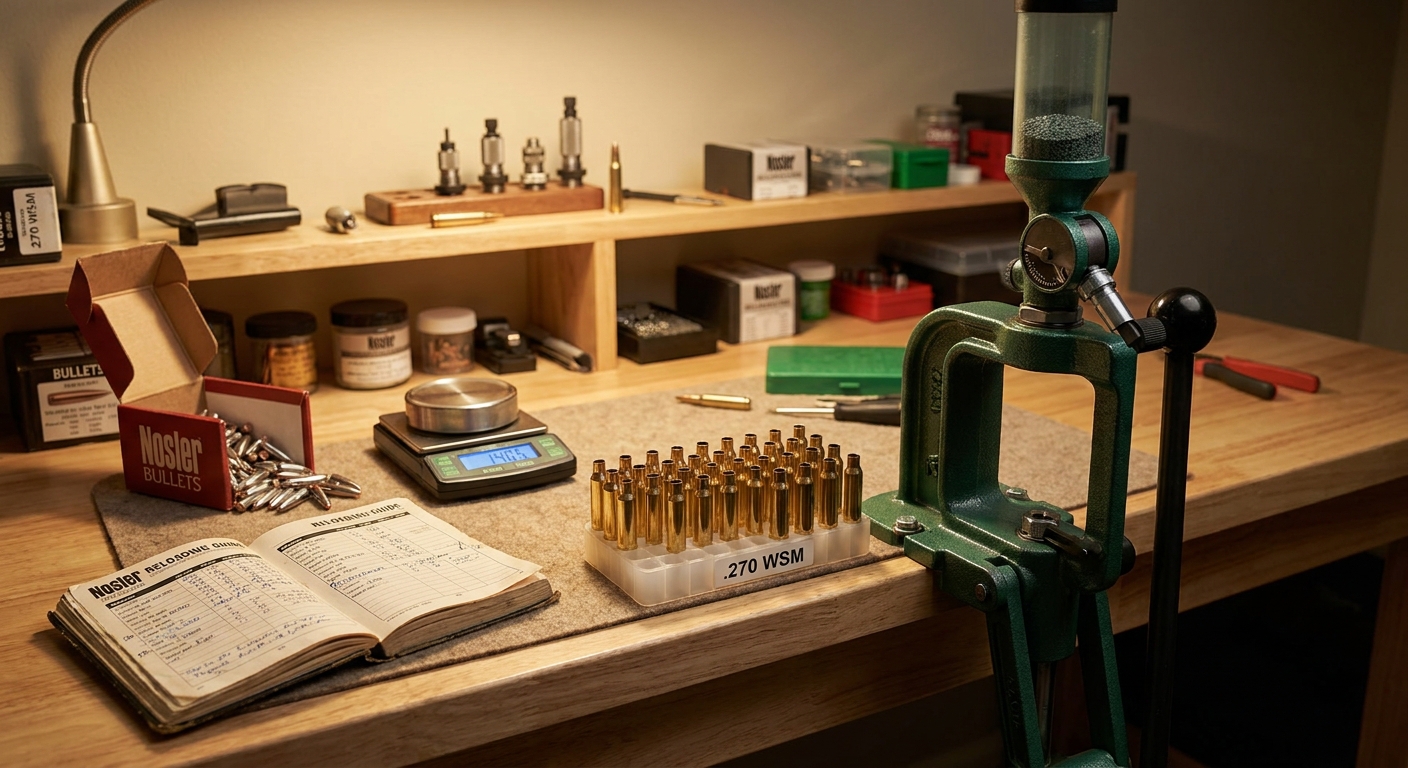
Winchester's Short Magnum family never got the attention it deserved, and the .270 WSM is the most underrated of the bunch. Introduced in 2002, it drives .277-caliber bullets at velocities that rival or exceed the standard .270 Winchester from a short-action receiver—and it does so with exceptional inherent accuracy. For handloaders who prefer a compact, fast-cycling rifle for mule deer, elk, and pronghorn at extended Western ranges, the .270 WSM is a cartridge worth building around.
The .270 WSM: Performance Overview
The .270 WSM runs in a short-action receiver with a 2.860-inch maximum overall length. It uses a large rifle primer, a rebated rim, and a 35-degree shoulder that promotes excellent headspace control and consistent ignition. Factory specifications call for a 55,000 PSI MAP—identical to the standard .270 Winchester and most standard magnums.
What the WSM case does well is pack a relatively large powder charge into a short, fat case with favorable internal geometry. The result is efficient combustion, consistent velocity, and—in quality barrels—sub-MOA accuracy that makes it competitive with purpose-built precision cartridges. Barrel length matters: a 24-inch tube is preferred for extracting full velocity, though 22-inch rifles are common and sacrifice only 30–50 fps in most loads.
Brass Selection and Preparation
Winchester manufactures the most widely available .270 WSM brass and is the practical choice for most handloaders. Nosler Custom brass offers tighter tolerances and more consistent primer pocket depth if you're building a precision load and want to minimize variables. Federal also offers .270 WSM brass periodically.
Case preparation is straightforward: full-length size with a quality WSM die set, trim to 2.100 inches (max is 2.110), deburr and chamfer the case mouth, and uniform primer pockets on new brass. The rebated rim requires that you use a shellholder designed for WSM cases—standard .30-06 shellholders will not work. Most die manufacturers include appropriate shellholders with their WSM sets.
Brass life is good if you don't chase maximum velocity. The fat case and moderate taper mean it spring-backs predictably after sizing, and primer pockets stay tight for four to six reloads in most scenarios before they begin to loosen.
Powder Selection
The .270 WSM has a case capacity that responds best to slow-to-medium-slow powders in the H4831–RL22 range. The following are well-proven choices:
- Hodgdon H4831SC: The most popular powder for the .270 WSM. Short-cut granules meter consistently through a powder measure and produce excellent velocity and accuracy with 130–150 grain bullets. Expect 3,100–3,150 fps with a 130-grain bullet from a 24-inch barrel at safe pressures.
- IMR 7828SSC: Another short-cut magnum powder that gives slightly higher velocity in some loads than H4831SC. Excellent results with 140–150 grain bullets for elk-class work.
- Reloder 22: Performs very well in the .270 WSM, particularly with heavier bullets in the 140–150 grain range. Can run slightly hotter than H4831SC in some lot combinations—work up carefully.
- Hodgdon Retumbo: A slower option suited to heavy-for-caliber bullets like the 150-grain Nosler AccuBond or 145-grain Berger Hunting VLD. Provides a velocity advantage with long, high-BC projectiles but can be sensitive to temperature extremes.
- Alliant Reloder 26: A temperature-stable magnum powder that has shown outstanding performance in WSM cases with 140–150 grain bullets. If you're hunting in variable summer/fall temperatures, RL26 is worth exploring for its reduced velocity spread across temperature ranges.
Bullet Selection
The .277-caliber bullet selection is deep and covers everything from deer-weight cup-and-cores to premium bonded and monolithic hunting projectiles.
For Mule Deer and Pronghorn
- 130-grain Nosler AccuBond: The go-to deer bullet for .270 WSM handloaders. High BC (0.488), bonded core, excellent accuracy, and reliable expansion to 200 yards and beyond.
- 130-grain Sierra GameKing: A classic and accurate hunting bullet at a price point that makes sense for practice loads as well.
- 130-grain Hornady ELD-X: The high-BC tip and Heat Shield design make it an excellent open-country deer bullet with a realistic 500-yard envelope when loaded to full WSM velocity.
For Elk
- 150-grain Nosler Partition: The original premium hunting bullet. Controlled expansion and deep penetration on elk-sized animals make the Partition the choice for hunters who want a reliable stopper, not maximum long-range BC.
- 150-grain Federal Trophy Bonded Bear Claw: Excellent penetration on quartering shots and heavy-boned animals. A serious elk bullet.
- 145-grain Berger Hunting VLD: If your priority is long-range precision and you're confident in your shot placement, the Berger at high WSM velocity gives you extraordinary BC and terminal performance past 400 yards.
Sample Starting Loads
Always begin 10% below maximum listed data and work up in 0.5-grain increments while watching for pressure signs. This data is for reference—consult current manufacturer reloading manuals before loading.
- 130gr Nosler AccuBond / H4831SC: Start at 62.0 gr, max around 66.0 gr. Expect 3,080–3,150 fps from 24 inches.
- 150gr Nosler Partition / IMR 7828SSC: Start at 61.0 gr, max around 64.5 gr. Expect 2,950–3,020 fps from 24 inches.
- 145gr Berger Hunting VLD / Retumbo: Start at 63.0 gr, max around 67.0 gr. Expect 3,000–3,060 fps from 24 inches.
Accuracy Tips
The .270 WSM rewards careful seating depth work. Start by seating to magazine length (2.860 inches COAL) and then experiment with jumping the bullet 0.010–0.040 inches off the lands for your specific rifle. Many .270 WSM chambers prefer bullets seated closer to the lands for maximum accuracy, though you'll need to verify this is still within safe magazine function.
Consistent primer seating depth—ideally 0.002–0.004 inches below flush—makes a measurable difference in this cartridge's inherently low extreme spread. A hand-priming tool with a feel indicator is worth using for hunting loads even if you've always primed on the press.
The Western Big Game Case
In a 7-pound short-action rifle, the .270 WSM hits harder than the standard .270 Win at equivalent ranges, cycles faster than a long-action belted magnum, and carries the same ammunition weight advantage. For the Western hunter packing into the high country for mule deer and elk, that combination matters. With careful handloading, you can build a load that prints sub-half-MOA at the bench, retains 1,800 ft-lbs past 500 yards, and fits in a rifle you're genuinely glad you carried up the ridge. That's hard to beat.