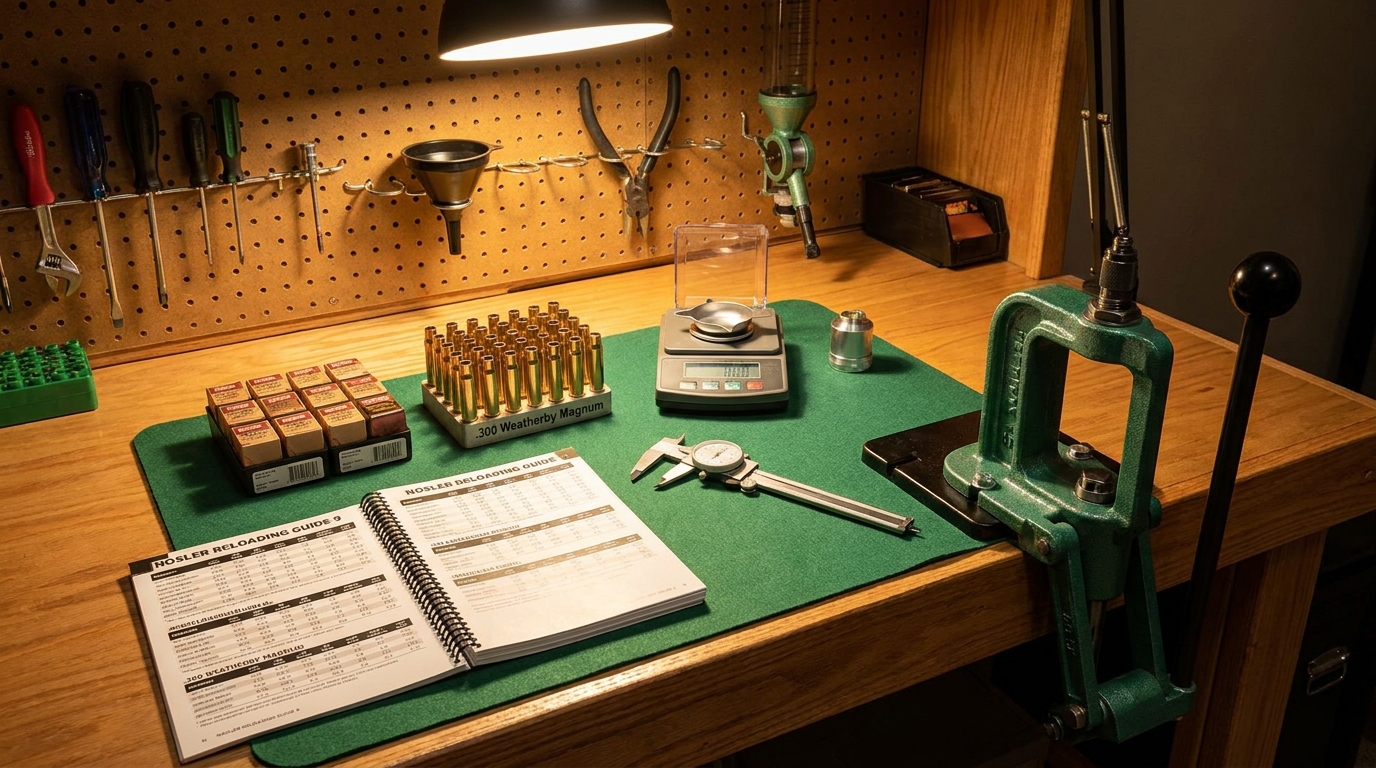
Roy Weatherby built his magnum cartridges on a simple premise: more velocity solves problems. The .300 Weatherby Magnum — introduced in 1944 and still one of the fastest factory-loaded .30 caliber cartridges available — pushes 180-grain bullets past 3,200 feet per second from a 26-inch barrel. That speed flattens trajectories, delivers energy at range, and makes it one of the most capable elk and mule deer cartridges ever chambered. If you're shooting a .300 Weatherby and want to get the most from the platform, handloading is the path forward.
Understanding the Case
The .300 Weatherby Magnum uses a full-length belted magnum case — the same belt diameter as the .375 H&H family — with Weatherby's trademark double-radius shoulder rather than the more common single-angle shoulder found on other magnums. This affects headspace: the .300 Weatherby headspaces primarily on the belt, not the shoulder, which means brass prep is important and case life can be shorter than on beltless designs if you chase maximum velocity too hard.
Case capacity is substantial — roughly 99 grains of water capacity, putting it ahead of the .300 Winchester Magnum and nearly equal to the .300 Remington Ultra Mag. That capacity is what enables Weatherby's velocity claims, but it also means slow-burning powders are the right choice.
Brass Selection and Prep
Weatherby brass is the standard and is excellent quality. Norma also produces high-quality .300 Weatherby brass. Avoid mixing brands once you've established a load — case capacity varies slightly between manufacturers and can affect pressure.
For case prep:
- Trim to length: 2.820 inches (SAAMI spec). Trim every firing.
- Anneal frequently: The large case body and high-pressure loads stress brass significantly. Annealing every 2–3 firings extends case life.
- Measure neck runout: Cases that have been fired multiple times can develop runout. Sort by runout and cull cases that exceed 0.003 inches TIR.
- Primer pocket: Large rifle magnum primer. Consistent seating depth — 0.002 to 0.005 below flush.
Powder Selection
The .300 Weatherby's large case requires slow-burning powders to reach its potential. Faster powders will generate pressure spikes before you reach useful velocity.
Top Powder Choices
- IMR 7828 / IMR 7828 SSC: The classic choice for the .300 Weatherby. Excellent velocity with good accuracy in most rifles. SSC meters better through powder measures.
- Hodgdon Retumbo: Outstanding choice, particularly with heavier bullets (200–225 grain). High energy density, consistent ignition, and excellent velocity potential.
- Hodgdon H1000: Slightly faster than Retumbo, excellent for 180–200 grain bullets. Very consistent lot-to-lot.
- Reloder 25 / Reloder 33: Alliant's top-end magnum powders produce excellent results with heavier projectiles and are worth working up if you can find them in stock.
- Hodgdon US869: Dense, high-capacity powder that can approach maximum case fill with heavy bullets. Requires a magnum primer and careful load development.
Bullet Selection for Western Big Game
180-Grain — The All-Around Choice
The 180-grain bullet is the workhorse of the .300 Weatherby. At 3,200+ fps, it shoots flat past 400 yards and delivers terminal performance well beyond what most elk hunting situations require. Top choices include the Nosler Partition (the gold standard for penetration and controlled expansion), Federal Trophy Bonded Tip, and Hornady ELD-X for hunters who want ballistic coefficient advantages at distance.
200-Grain — For Bigger Bears and Heavy Timber
When hunting Roosevelt elk in Oregon's coast range or pursuing black bear in dense cover, a 200-grain partition or Swift A-Frame offers deeper penetration and more retained weight after impact. Velocity drops slightly, but terminal performance at under 300 yards is hard to argue with.
165-Grain — Open Country and Pronghorn
For eastern Oregon pronghorn and mule deer where the shots are long and targets are lighter, a 165-grain high-BC bullet like the Berger Hybrid or Nosler AccuBond Long Range at 3,300+ fps is a formidable combination.
Starting Load Data
Always consult a current, published reloading manual for your specific components. The following represents approximate working range data — always start 10% below max and work up carefully while watching for pressure signs.
180-grain Nosler Partition / IMR 7828 SSC: Start around 79.0 grains, max approximately 84.0 grains. Expect 3,150–3,250 fps in a 26-inch barrel.
180-grain Hornady ELD-X / Hodgdon Retumbo: Start around 83.0 grains, max approximately 88.0 grains. Expect 3,180–3,280 fps in a 26-inch barrel.
200-grain Nosler Partition / Hodgdon H1000: Start around 78.0 grains, max approximately 83.0 grains. Expect 2,950–3,050 fps in a 26-inch barrel.
Pressure Signs to Watch
The .300 Weatherby operates at high pressure — 65,000 PSI SAAMI maximum. Because the case headspaces on the belt, case head expansion is not as reliable a pressure indicator as on beltless cartridges. Watch for:
- Difficult bolt lift
- Flattened or cratered primers
- Ejector marks (small circle impressed on case head)
- Excessive case stretching near the belt
If you see any of these, back off. The .300 Weatherby doesn't need to be pushed to its absolute limit to be effective — even mid-range loads are fast by most cartridge standards.
In the Field
The .300 Weatherby generates significant recoil — typically 35–45 ft-lbs in an 8-pound rifle depending on load. If you're recoil-sensitive, load development at the bench can become uncomfortable quickly. Use a recoil pad, shoot from a supported position during load work, and take breaks. Developing a flinch in a recoil-heavy caliber will cost you more accuracy than the extra velocity is worth.
In the field, the .300 Weatherby's velocity means very little holdover is needed at hunting ranges. A 200-yard zero puts you roughly 3 inches high at 100 yards and 7–8 inches low at 300 yards with a 180-grain load, depending on BC. Build your DOPE chart before the season and confirm it at field distances.