Oregon isn't a state most hunters associate with whitetail deer. Ask someone to name an Oregon big game animal and you'll hear elk, mule deer, pronghorn — maybe blacktail. But tucked into the drainages of the Blue Mountains in Wallowa, Union, Baker, and Umatilla counties, a healthy population of Rocky Mountain whitetail lives mostly below the radar. And in late season — when snow pushes deer to lower elevations and hunting pressure has long since thinned — they become more vulnerable to a patient, prepared hunter than at almost any other time of year.
Where Oregon's Whitetail Live
Oregon's whitetail population is concentrated in the northeast corner of the state, primarily in the river drainages and lower-elevation timbered terrain of the Blue Mountains. Key areas include:
- Wenaha-Tucannon Wilderness corridor: The lower-elevation fringe and adjacent private agricultural lands hold excellent numbers of deer
- Grande Ronde River drainage: One of Oregon's most productive whitetail corridors; deer concentrate in the riparian zones and lower timber in late season
- Imnaha River canyon: Lower canyon elevations are deer winter range; access is challenging but the deer density rewards the effort
- Umatilla River drainage: Public land adjacent to wheat and hay ground in Umatilla County holds whitetail year-round
- Powder River basin (Baker County): Overlooked by most hunters; a mix of private ag land and public timber holds deer that congregate near feeding areas in winter
Oregon Whitetail Hunting Units and Tags
Oregon's whitetail deer hunting falls under the general deer tag system in most units, which means these are over-the-counter tags — no draw required for many seasons. Key units to know:
- Wenaha Unit (Unit 50): Straddles the Washington border; holds whitetail in lower elevations and riparian corridors. General season runs into late October for rifle.
- Sled Springs Unit (Unit 51): Excellent habitat along the Grande Ronde and its tributaries; some of the best public-land whitetail hunting in the state
- Chesnimnus Unit (Unit 52): Wallowa County; Imnaha drainage; challenging terrain but good deer numbers
- Mt. Emily Unit (Unit 57): Adjacent to Pendleton in Umatilla County; accessible terrain with late-season whitetail opportunities near agriculture
Check the current ODFW Big Game Regulations for exact season dates — general rifle seasons typically run late October through mid-November, with some units offering extended seasons. Controlled late-season hunts are also available by drawing in certain units and offer excellent opportunity during the most productive time of year.
Why Late Season Is the Best Season
Most Oregon hunters are done by mid-November. The weather is cold, snow is possible, and elk season has closed. But for whitetail specifically, late season after the rut is often the most productive time to be in the field:
- Winter feeding patterns: Post-rut bucks are depleted and focused on rebuilding fat reserves. They feed heavily on predictable food sources — standing corn or wheat stubble on private land, natural browse in riparian areas, south-facing slopes with residual forage.
- Elevation concentration: December snow pushes deer off the high country and concentrates them on winter range. You don't need to cover miles — the deer come to defined areas.
- Pressure is gone: Opening week of rifle season sees every camp spot filled. By late November and December, you often have the mountains to yourself.
- Buck movement: The post-rut "second rut" can stir buck movement in late November as unbred does cycle again. Mature bucks that went nocturnal during the hunting pressure of early season begin moving again in daylight.
Late-Season Tactics for Northeast Oregon Whitetail
Hunt Food Sources
This is the single most important tactic in late season. Find where deer are feeding and be there at first and last light. In the Grande Ronde and Umatilla country, winter wheat fields and hay meadows adjacent to timber are gold. On public land, focus on south-facing draws with residual shrub cover — bitterbrush, snowbrush, and low-elevation mountain mahogany that retains browse value through winter.
Work the Thermals
Late-season hunting in canyon country means paying attention to thermals. Cold mornings pull air down-canyon; warming afternoons push thermals upslope. Set up accordingly — approach from downwind using the topography, not against it. In the deep canyons of the Imnaha and Grande Ronde, thermals can be dramatic and predictable.
Glass First, Move Second
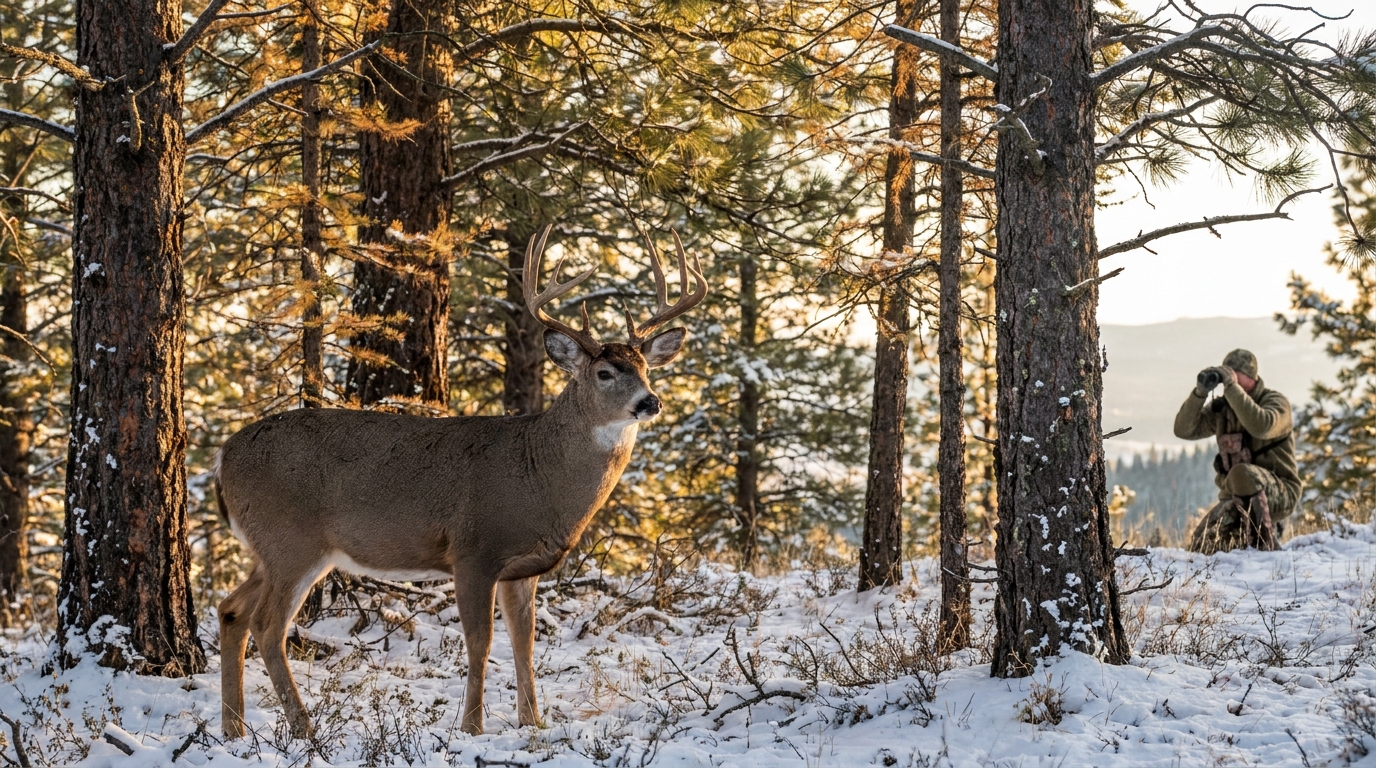
The Blue Mountains are glassing country. Park at elevation and glass the south-facing slopes and riparian corridors below before committing to a stalk. Whitetail in late season often bed on south slopes in mid-morning sun, then move to feeding areas in late afternoon. Locating deer from a distance before closing the gap is far more efficient than push-walking through timber.
Treestand and Ground Blind Setups
If you've done pre-season scouting (or know the country from prior years), a treestand or ground blind set over a well-used trail connecting timber bedding to a feeding area is deadly. Set the stand on the downwind side of the approach trail. Late-season deer are routine — once you've confirmed a travel pattern, the setup is just a matter of execution.
Drive the Timber Pockets
Group hunting for late-season whitetail in the Blue Mountains can be highly effective. Small timber pockets adjacent to feeding areas often hold deer that have patterned on a specific bedding-to-feeding route. Two hunters driving toward a third positioned on a likely escape route is a classic and effective tactic for these terrain features.
Gear for Late-Season Northeast Oregon Conditions
The Blue Mountains in December can be severe. You need to dress for extended cold with the capability to shed layers during a stalk:
- Base layer: Merino wool or synthetic moisture-wicking layer — no cotton
- Insulation: 100-200g synthetic puffy for active movement; add a 200g down layer for stand hunting
- Outer shell: Windproof, water-resistant — Gore-Tex or equivalent for wet snow
- Footwear: 1000-gram insulated hunting boots with aggressive lugs for icy slopes; gaiters for deep snow
- Traction devices: Microspikes for canyon access roads and steep slope approaches
Rifle Recommendations for Timber and Canyon Country
Northeast Oregon whitetail hunting is rarely long-range. Most shots in canyon timber and riparian corridors come inside 200 yards, with many under 100. You don't need a long-range setup. What you need is a rifle that handles reliably in cold, wet conditions and hits hard at moderate ranges:
- .30-30 Winchester in a Marlin 336 — the classic lever-gun timber deer rifle; quick handling in brush
- .308 Winchester — versatile, available in short-action bolt guns, adequate for any shot you'll encounter
- .30-06 Springfield — proven on everything in this terrain; ample power for the occasional longer cross-canyon shot
- 7mm-08 Remington — mild recoil with excellent terminal performance; a great choice if you're sharing a rifle with a younger hunter
Access and Logistics
La Grande, Enterprise, Baker City, and Pendleton are your base towns. USFS roads into the Blue Mountains are often passable into December with a 4WD vehicle and chains, but confirm conditions before committing to a remote camp. Many hunters base camp out of pickups or wall tents near the snow line and day-hunt the lower drainages on foot.
ODFW's Northeast Region office in La Grande (541-963-2138) can provide current unit-specific information, and their annual winter range monitoring data is sometimes available on request — useful for identifying where deer are concentrated in a given year.
A Realistic Expectation
Oregon's Blue Mountains whitetail hunting isn't the agricultural Midwest experience. These are wild deer in rugged country. Tags are over-the-counter in most seasons, but filling one requires genuine woodsmanship, physical fitness for canyon terrain, and patience. What it lacks in convenience it makes up for in wildness — and a Grande Ronde river-bottom buck in late November is a trophy by any standard.