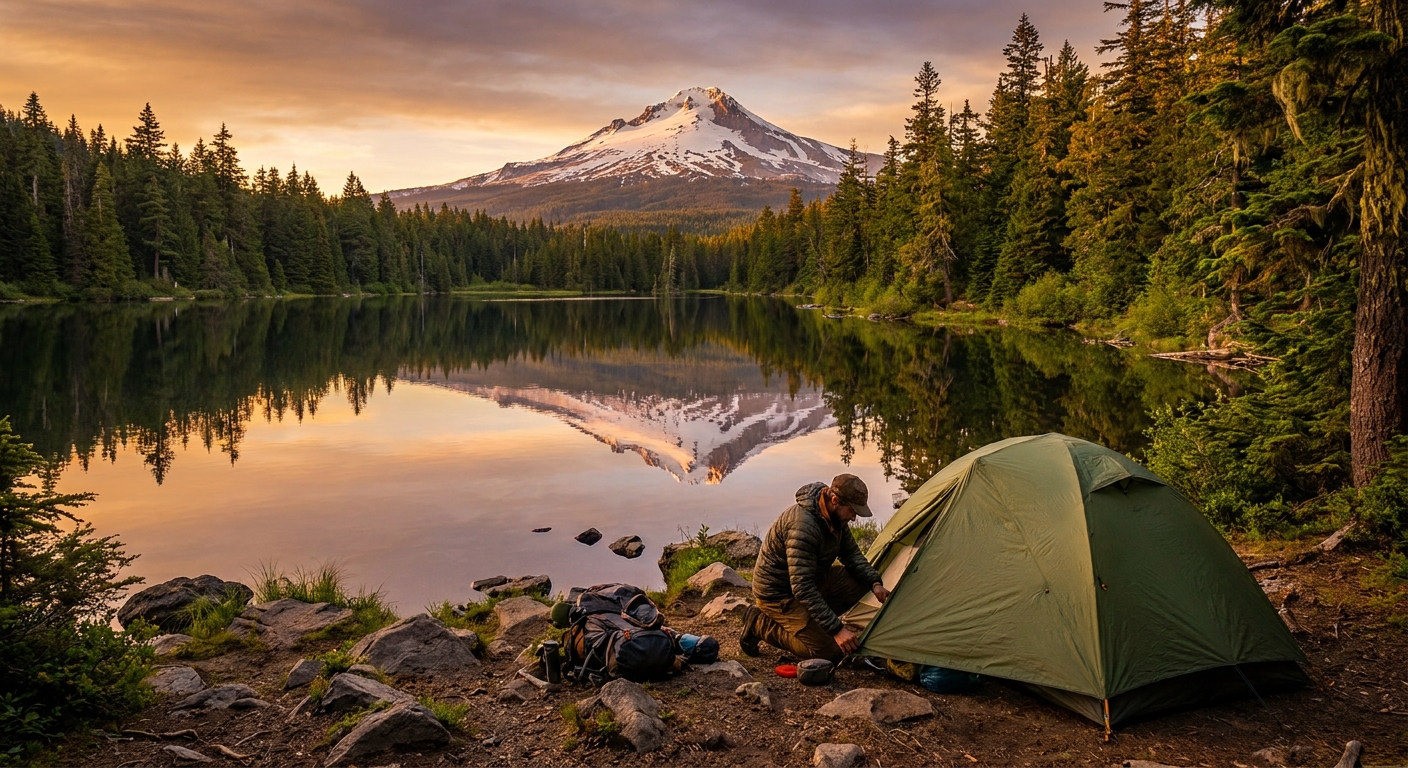
Some places in Oregon's backcountry require commitment — multi-day approaches, technical terrain, remote trailheads that demand a full tank of gas and a high-clearance rig. Lost Lake is not one of those places. But don't mistake accessible for unspectacular. This gem tucked into the Hood River County forest delivers one of the finest basecamp experiences in the entire Oregon Cascades: old-growth Douglas fir pressing in from every direction, a lake so calm on still mornings that Mount Hood’s reflection is indistinguishable from the mountain itself, and a summer atmosphere that feels genuinely remote despite being 90 minutes from Portland.
Getting There
Lost Lake sits at 3,143 feet elevation in the Hood River Ranger District, accessible via Lost Lake Road from the town of Hood River. From Portland, take I-84 east to Hood River (exit 62), then follow the signs southwest through Dee and into the forest. The drive from Hood River to Lost Lake is approximately 25 miles and takes about 45 minutes on paved forest road. A Northwest Forest Pass or America the Beautiful pass is required for day use; the campground charges nightly fees for car campers.
True backpackers have two primary options: park at the day-use area and access the Lakeshore Trail and connecting routes on foot, or drive to the campground and use it as a vehicle base while day-hiking the surrounding forest. For a genuine overnight backpacking experience away from car campers, the Lost Lake Loop and the connecting trail toward Preacher’s Peak offer excellent options.
The Lakeshore Loop
The 3.2-mile Lakeshore Trail circumnavigates the lake entirely through old-growth forest. This is the orientation walk — do it first, ideally at first light or in the last hour before sunset when the Mount Hood reflection is most dramatic and other visitors are scarce. The old-growth western red cedar and Douglas fir along the south and west shores are among the most impressive old trees accessible by an easy trail anywhere in the Oregon Cascades. Several individual cedars measure over 6 feet in diameter.
The north shore offers the classic postcard view: open sky over the lake, Mount Hood’s summit rising 11,249 feet above sea level perfectly centered in the frame, forests sweeping up the volcano’s flanks. Bring a tripod if you shoot photos. This is a spot worth lingering at.
Preacher’s Peak and the Ridge Country
For those wanting more elevation and solitude, the trail climbing south from the lake toward Preacher’s Peak (elevation 4,200 feet) enters genuinely quiet forest within about 15 minutes of leaving the lake. This route connects to a network of trails in the Mount Hood National Forest that allow you to build multi-day loops incorporating ridge walks with views into the Hood River Valley, Columbia River, and on clear days, all five major Cascade volcanoes from Rainier to Jefferson.
The Preacher’s Peak trail gains about 1,100 feet over 2.5 miles. It’s well-maintained but can be muddy early in the season. By mid-July it’s typically dry and hikeable. Camping near the summit area provides isolation from the lake’s more social camping environment and positions you for a sunrise view that’s hard to match anywhere in the northwest.
Fishing Lost Lake
Lost Lake is stocked with rainbow trout by ODFW and fishes well throughout summer. The resort rents rowboats and canoes for those who want to cover water, but bank anglers do well working the inlet stream area on the south end of the lake and along the rocky points where the old-growth leans out over the water.
Standard trout tactics apply: small spinners (Panther Martin #4 in gold or silver), Rooster Tails, Power Bait on a slip sinker rig near bottom in the deeper center sections, or fly fishing with dry flies during the evening caddis and midge hatches. The lake’s elevation keeps water temperatures comfortable for trout well into August, and fishing pressure is lighter on weekdays. A valid Oregon fishing license is required.
What to Pack for a Lost Lake Weekend
- Shelter: A lightweight backpacking tent or tarp. Car campers can obviously bring more, but the move toward the ridge requires a packable setup.
- Layers: July nights at 3,000+ feet cool rapidly. A down or synthetic puffy jacket and a fleece mid-layer are non-negotiable even in midsummer.
- Rain gear: The Hood River area sits in a microclimate that generates afternoon convective storms in July. A lightweight waterproof shell weighs almost nothing and earns its place every trip.
- Bear canister or hang kit: Black bears are present throughout the Hood River Ranger District. Store food and scented items properly every night.
- Fishing gear: A 6-foot ultralight spinning rod broken down into a pack-friendly case and a small tackle box adds almost no weight and opens up an entirely different dimension of the trip.
- Camera: Obvious, but don’t leave it in the car. The reflection shots from the north shore are legitimately one of the most photogenic scenes in Oregon.
Logistics and Permits
Lost Lake Resort and Campground manages the recreation area under permit from Hood River County. The campground fills on summer weekends — reservations are strongly recommended from July through Labor Day. The day-use area typically has space for non-overnight visitors even when the campground is full. Vault toilets and running water are available at the main campground area.
There are no overnight permits required for backcountry camping in the surrounding Mount Hood National Forest, but Leave No Trace principles apply. Camp at least 200 feet from water sources, and use a stove rather than open fires during fire restrictions, which are frequently in effect throughout July and August in this zone.
Best Time to Visit
Late June through early October is the prime window. Snow can linger on the higher ridge routes into June in heavy years. Mid-July to mid-August is peak season with the longest days and warmest swimming temperatures, but also the most competition for campsites. The two weeks after Labor Day are often the sweet spot: summer conditions persist, crowds thin dramatically, and the first hints of fall color begin appearing in the vine maple and huckleberry understory.
If you’ve been overlooking Lost Lake because it doesn’t have the remote mystique of the Eagle Cap or Three Sisters, it’s time to reconsider. The old-growth forest, the mountain reflection, and the evening rises on the lake make this one of the most complete outdoor experiences in the Oregon Cascades — and you can be set up and fishing by noon on a Saturday morning without leaving Portland before dawn.