Odds of drawing an Oregon mountain goat tag hover around 1–3% in most units. That's not a typo. These are lifetime tags for most hunters — the kind of permit that, when it arrives in your inbox, stops you cold. If you've put in for mountain goat in Oregon and haven't given serious thought to how you'll hunt it when the tag comes, this is your primer.
Oregon's Mountain Goat Population and Units
Rocky Mountain goats (Oreamnos americanus) were introduced to Oregon starting in the 1960s and have established huntable populations in several mountain ranges. ODFW manages goat hunting across a handful of limited-entry units, with populations concentrated in the Wallowa Mountains of northeast Oregon and the Elkhorn Range near Baker City.
Key Units
- Wallowa Unit: The flagship goat unit in Oregon, with the highest population and the most tags issued. The Wallowas are legitimate alpine — 9,000-foot ridgelines, cirque basins, and vertical cliff faces that goats call home year-round. This is where the majority of Oregon trophy billies come from.
- Elkhorn Unit: The Elkhorn Range southwest of Baker City holds a smaller population. Unit is more accessible than the Wallowas, with some elk hunting roads providing high starting points for goat country.
- Hells Canyon Unit: A tougher draw and a unique hunt — goats here occupy the canyon rimrock and high basalt breaks on both the Oregon and Idaho sides. Not classic alpine terrain, but extremely rugged country with very limited human pressure.
Tag numbers are typically in the single digits per unit per season. ODFW issues separate tags for billy (male) and nanny/kid restrictions apply — always read the tag conditions carefully, as goat management in Oregon prioritizes population health over harvest numbers.
Season Timing and Why It Matters
Oregon's mountain goat season typically runs from late August through November, with the exact dates set by ODFW in the annual regulations. Early season (August–September) offers the most pleasant hunting conditions — stable weather, accessible snowpack, and goats in their summer range near ridgeline terrain features.
By October, early storms push into the high country and goats begin shifting toward lower cliff faces and talus slopes where they winter. Late-season hunters deal with snow, cold, and more challenging access, but goats in full winter coat are spectacular trophies, and the rut (November in most areas) brings billies into predictable locations as they follow nannies.
Most successful Oregon mountain goat hunters target August and September. The weather cooperates, you can glass effectively at distance, and goats haven't been pressured by other hunters.
Glassing Strategy: How to Find Goats in Big Alpine Country
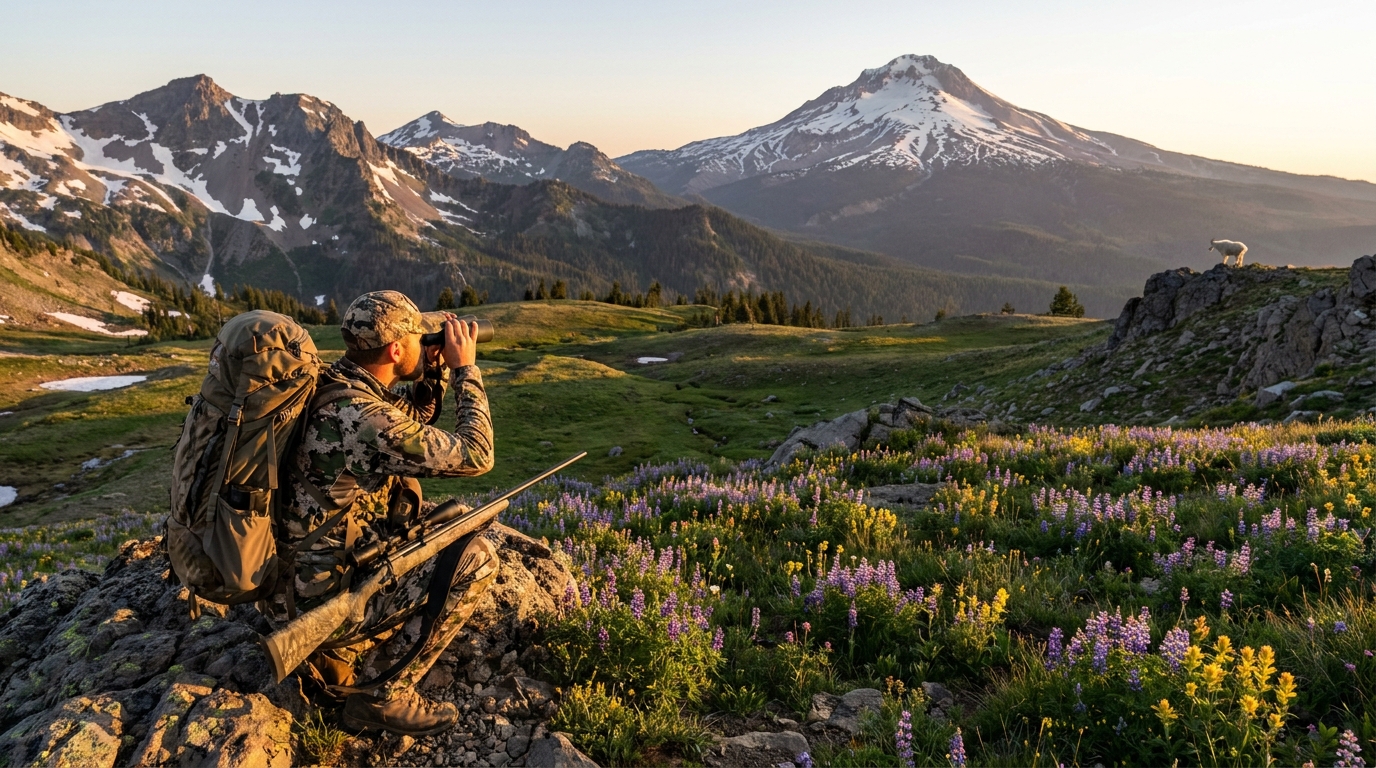
Mountain goats are white. In rocky alpine terrain with snowfields and light-colored talus, they can be surprisingly difficult to pick up at distance. The key is understanding their daily routine and preferred terrain features.
Where Goats Are
- Cliff faces and ledge systems: Goats feel secure on vertical terrain. They bed on ledges where nothing can approach them from above and where they can see threats at distance below. Look for white specks against grey cliff faces in early morning and late evening.
- High-ridge mineral licks: Natural mineral deposits on high ridgelines attract goats, especially in summer. Locating these pre-season via scouting or aerial imagery can put you near concentrated animals.
- Snowfield edges: On hot August days, goats seek out snowfield edges to escape insects. Glass the transition zones between snowfields and talus.
- Midday bedding: Goats often bed on near-vertical ledges during midday heat. They look like white boulders — look for animals that are slightly too bright and slightly too oval.
Glass Setup
Quality optics are non-negotiable in goat country. A 15x56 binocular on a tripod for primary glassing, backed up by a 65–80mm spotting scope at 25–60x for animal evaluation. Billies are identified by horn shape (more vertical and less curved than nannies), a pronounced shoulder hump, and overall body mass. A mature billy in Oregon's Wallowas will carry 9–10 inch horns with good mass at the base.
The Hunt: Moving on Goats in Alpine Terrain
Mountain goat hunting is almost always a spot-and-stalk proposition, but the "stalk" part is misleading. Goats don't spook the way deer and elk do — they're apex users of terrain that most predators won't follow them onto. What kills a goat hunt isn't spooked animals; it's unsafe terrain decisions by hunters who push too hard into cliff systems they shouldn't be in.
The correct approach is patience and route-finding. Use topographic maps and terrain assessment to identify a safe approach path to within ethical shooting range. Most goats are taken at 100–300 yards. Match your approach to the terrain, not the animal's comfort level. If you can't safely access the cliff face, glass from below and wait for the goat to move to more accessible terrain.
Gear Requirements
Mountain goat country demands real mountain gear. This isn't an elk camp setup adapted for high country:
- Footwear: Stiff-soled mountain boots with aggressive lug soles. Lightweight hikers fail on wet talus and ledge systems. Prioritize ankle support and grip over weight savings.
- Rifle: A flat-shooting cartridge in the 6.5 Creedmoor through .300 Win Mag range handles any shot you'll encounter. This isn't a long-range hunting situation as much as an access situation — most shots are under 200 yards, but you want the capability for longer if the terrain demands it.
- Pack: A 40–50 liter daypack for day hunts, a 65–70 liter frame pack for multi-day backcountry approaches. Goat quarter meat plus hide and horns pack out heavier than you expect from an animal that size.
- Navigation: GPS unit loaded with topo maps, paper maps as backup. Cell service is nonexistent in the Wallowa high country.
After the Shot: Field Care
Goat hides are thick and hold heat — cape and quarter immediately after the shot. A goat in late August or September will spoil quickly if left intact in warm temperatures. The hide is a significant part of the trophy, so take care skinning the cape for a shoulder mount. Horns are not particularly large but are distinctive and make excellent European mounts.
Building Your Points and Applying Smart
If you haven't drawn yet, apply every year. Oregon uses a preference point system for most controlled hunts including mountain goat. Your points accumulate every year you apply without drawing, increasing your odds incrementally. Check ODFW's odds reports (published annually) to understand draw odds by unit and point level — then commit to the unit with the best odds for your point total rather than always targeting the most popular unit.
Mountain goat hunting in Oregon is a once-in-a-lifetime experience for most hunters. Treat it accordingly. Prepare like it's the only tag you'll ever have — because for many of us, it will be.