By the time February rolls around in Oregon, most waterfowl hunters have packed their gear and moved on. That's a mistake. The Light Goose Conservation Order (CO) — which typically runs from late January through mid-April in the Pacific Flyway — gives hunters a second wind with relaxed rules designed to help biologists reduce an overabundant snow goose population that's literally destroying Arctic and sub-Arctic breeding habitat.
This isn't your standard goose season. Under the Conservation Order, the rules change in ways that can feel almost surreal if you've only hunted under regular season frameworks. Understanding those rules — and how to exploit them — is the difference between watching geese and killing geese.
What the Conservation Order Changes
The U.S. Fish and Wildlife Service created the Light Goose Conservation Order in 1999 specifically because snow goose and Ross's goose populations had grown so large that they were stripping coastal and inland Arctic marshes bare. Under the CO, several standard restrictions are lifted:
- No daily bag limit on snow geese, Ross's geese, and blue geese
- Electronic calls are legal — this is the big one
- Extended season dates beyond the regular goose season closure
- Unplugged shotguns are allowed (more than 3 shells in the magazine)
You still need a valid Oregon hunting license, a Federal Duck Stamp, and a Harvest Information Program (HIP) registration. Non-toxic shot is required. Know your species — these rules apply only to light geese (snow, Ross's, and blue geese). Canada geese and cacklers do not fall under the CO.
Where to Hunt in Oregon
Klamath Basin
Southern Oregon's Klamath Basin is one of the great concentration points for light geese on the entire Pacific Flyway. The Klamath Basin National Wildlife Refuge Complex — including Lower Klamath and Tule Lake NWRs — holds staggering numbers of birds during migration. Hunt fields adjacent to refuge boundaries where geese move out to feed in harvested grain and pasture.
Columbia River Basin
The Columbia River corridor in north-central Oregon and the areas around Hermiston, Boardman, and Umatilla draw large concentrations of migrating snow geese. Agricultural land in this zone — particularly harvested corn and wheat stubble — is prime feeding habitat. Knock on doors or check with local outfitters; permission to hunt private land in this corridor is worth pursuing.
Willamette Valley
Snow geese aren't always the primary target in the Valley, but they do move through in numbers some years. Keep your eyes on eBird and waterfowl reports from late January forward — when birds are moving, they can be in fields alongside the large resident populations of cackling Canada geese.
Decoys: Go Big or Go Home
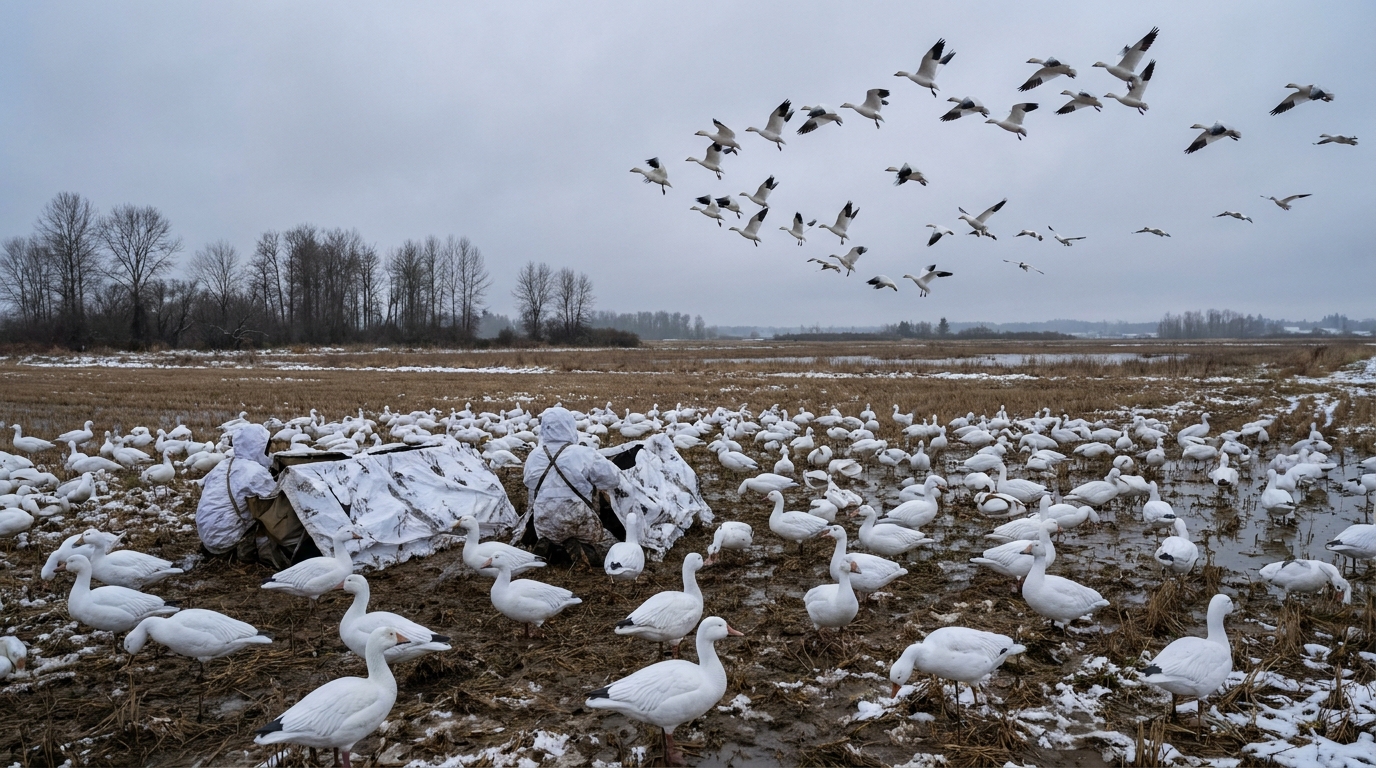
Snow goose hunting is a volume game. A spread of 50 decoys that would murder Canada geese will barely get a flock of snows to break formation. Serious snow goose hunters put out 300 to 1,000+ decoys. Wind-sock decoys (motion socks) and shell decoys are the standard — motion in the spread is critical because real flocks of snow geese look like a churning white mass from the air.
Set your spread in a tight J or C shape with the open end into the wind. Leave a landing zone — snows want to work into the pocket. Put your motion decoys (full-body flappers or rocker decoys) on the upwind edge where birds will see them first.
Electronic Calls and What to Run
With e-callers legal under the CO, you can run a Bluetooth speaker, a purpose-built game caller, or even a phone with a speaker as loud as you can manage. Volume matters — snow geese are loud birds that communicate constantly in flight, and you want your spread to sound like a thousand birds on the ground.
The most effective sounds: feeding chatter (continuous low-level calling), landing calls as birds commit, and contact calls to get their attention at distance. Apps like Goose Hunter Pro and Sound Devices' snow goose libraries give you a range of options. Let the electronic caller run continuously and adjust volume based on wind. Turn it off when birds are in close and committed — sometimes silence closes the deal.
Identifying Your Birds
Snow geese are white-bodied with black wingtips and a pink bill. Blue-phase snow geese have dark gray-brown bodies with white heads — they're the same species, just a different color morph. Ross's geese look like small snow geese with a stubbier bill and no black "grinning patch." All three are legal under the CO. Practice your identification before the season so you're not second-guessing yourself when a mixed flock works your spread.
Planning Next Season
The Pacific Flyway CO dates shift year to year based on USFWS determination — check the Federal Register and ODFW's waterfowl season summaries in fall for the upcoming year's dates. Start reaching out to landowners in prime areas well ahead of time. Snow goose hunting in Oregon is a legitimate late-winter opportunity that most hunters overlook entirely, which means the birds are often less pressured here than in the Central Flyway where the CO is well-established and widely hunted.
Don't pack the decoys away in January. The best hunt of your season might still be coming.