The red dot sight has spent most of its life on AR-15s, handguns, and competition rigs. But over the past decade, a growing number of hunters — particularly those who pursue deer, elk, and bear in dense timber or brushy terrain — have discovered that a properly zeroed red dot is one of the most practical hunting optics ever made. If your shots are consistently inside 150 yards, a red dot deserves serious consideration.
The Case For Red Dots in the Timber
Traditional magnified scopes are exceptional tools for the conditions they were designed for: defined, medium-to-long range shots on open terrain. But in the Coast Range pursuing blacktail deer, in the Cascades bowhunter-density elk habitat, or stalking black bear in tight brush, magnification can actually work against you. A 4x or 6x scope narrows your field of view at the exact moment you need maximum situational awareness.
A red dot sight at 1x offers the widest possible field of view, both-eyes-open target acquisition, and the ability to track a moving animal through cover that would make a scoped shot impossible. For dedicated close-cover hunters, this is not a compromise — it's the right tool.
What to Look For in a Hunting Red Dot
Not all red dots are created equal, and hunting environments demand more from an optic than range use does. Prioritize the following:
Durability and Waterproofing
Your optic will get rained on, knocked around in the truck, and possibly dropped. Look for a minimum IPX7 waterproof rating and a housing that has passed mil-spec or equivalent drop tests. Brands like Trijicon (MRO, SRO), Aimpoint (Micro T-2, CompM5), and Leupold (DeltaPoint Pro) have reputations built on durability in the field.
Battery Life
This matters more in hunting than in tactical use because your rifle may sit in a safe for months between hunts. The Aimpoint Micro T-2 has a legendary 50,000-hour battery life on its middle brightness setting — you can install a battery and essentially forget it for 5+ years. This is the standard to measure others against.
Dot Size
Red dots are measured in MOA. A 2 MOA dot covers about 2 inches at 100 yards — precise enough for ethical hunting shots, small enough to allow accurate placement. A 6 MOA or larger dot is harder to place precisely at any range. For hunting rifles, 2-4 MOA is the sweet spot.
Brightness Range
You need a dot bright enough to see in direct Oregon summer sunshine and dim enough to not bloom against a dark timber background at dawn. Quality red dots offer 8-12 brightness settings spanning daylight, low light, and NV-compatible settings. The auto-brightness feature on some models (Leupold Freedom RDS, for example) is genuinely useful in changing light conditions.
Top Red Dot Options for Hunting Rifles
- Aimpoint Micro T-2 ($900): The gold standard. Used by military forces worldwide, virtually indestructible, and the battery life is genuinely unmatched. The 2 MOA version is the right choice for hunting.
- Trijicon MRO ($500): Excellent glass quality with a large objective lens that creates a wide, clear sight picture. More compact than many alternatives. Battery life is shorter than the Aimpoint (5 years on a CR2032 at setting 4), but still excellent for hunting.
- Vortex SPARC Solar ($350): Solar-assisted battery charging adds a practical element for hunters who spend extended time in the field. The optical quality is solid for the price point and Vortex's lifetime warranty is among the best in the industry.
- Leupold DeltaPoint Pro ($450): A compact, lightweight option that works well on lever-action rifles and short-barreled carbines. The motion-sensing auto-activation is a nice feature for hunting carry.
- Sig Sauer ROMEO5 ($170): The best budget option that actually meets hunting standards. Not quite in the same tier as Aimpoint or Trijicon for long-term durability, but a solid performer for the price and a great entry point.
Mounting: Getting It Right the First Time
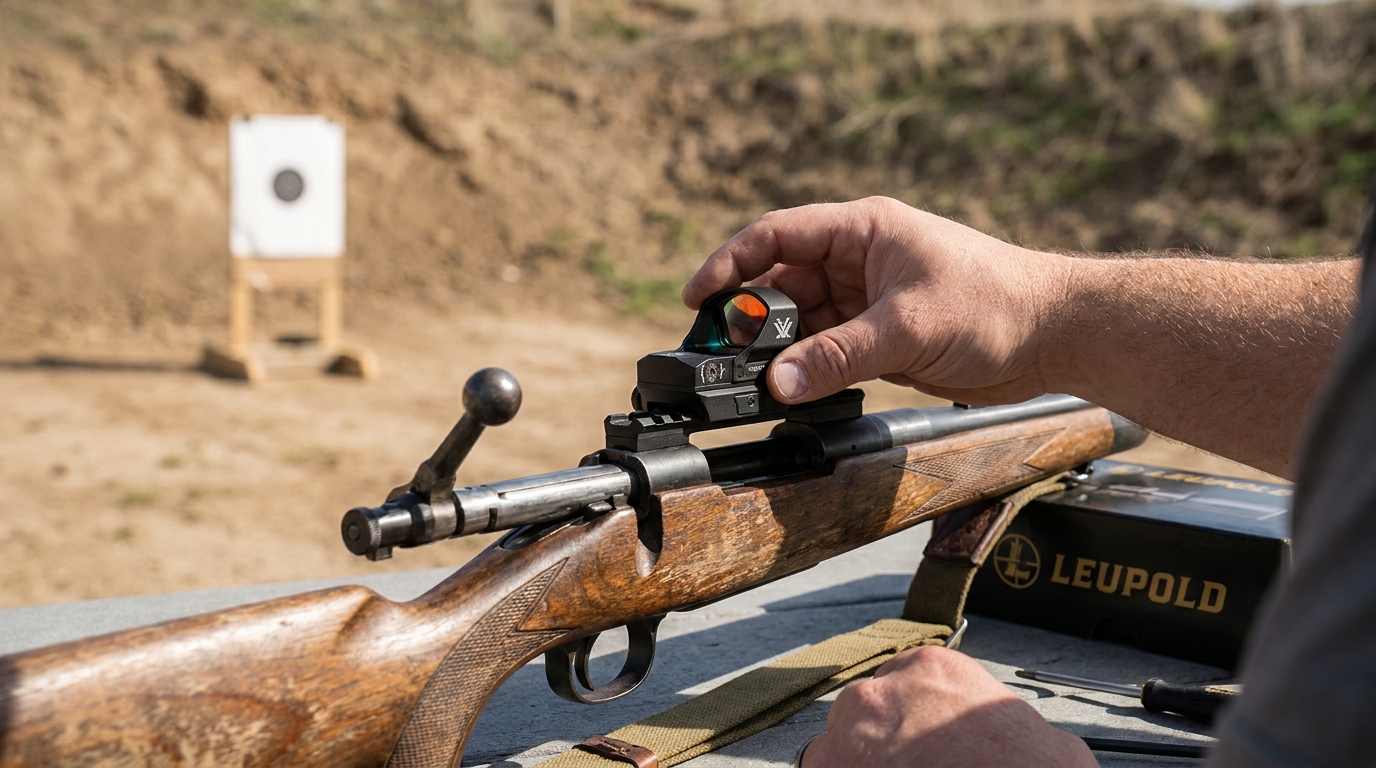
A red dot is only as good as its mount. For lever-actions, AR-platform rifles, and semi-autos, a quality Picatinny rail mount (Midwest Industries, American Defense Manufacturing, or LaRue Tactical) offers the most secure attachment. For bolt-action rifles without a factory rail, a Weaver or Picatinny scope base from Talley or Leupold provides a solid foundation.
Eye relief on a red dot is effectively unlimited — the dot appears in focus regardless of how close or far your eye is from the sight. Mounting height, however, matters. Mount the optic as low as possible while still allowing a proper cheek weld. Most dedicated hunting hunters use a 1-inch or 1.45-inch riser to achieve proper head position. If you need to strain your neck to see the dot, raise the mount.
Use threadlocker (medium strength, blue Loctite) on all mount screws and torque to spec. A red dot that shifts under recoil is useless and potentially dangerous.
Zeroing Your Red Dot for Hunting
The most practical hunting zero for a red dot depends on your cartridge and expected shot distances. For .30-30, .45-70, or similar cartridges typically used in timber with shots inside 100 yards, a 50-yard zero puts you within 2-3 inches of point of aim from 0 to 100 yards on most loads.
For faster cartridges used in more open terrain — even with a red dot — a 100-yard zero works well out to 150 yards with most deer-hunting loads.
Zeroing Process
- Start at 25 yards to get on paper quickly. Adjust the dot to hit point of aim at 25 yards.
- Move to your final zero distance (50 or 100 yards) and make final adjustments.
- Confirm zero from field shooting positions — sitting, kneeling, off a pack — not just from a bench.
- Shoot at least 10 rounds to confirm the zero is stable and not shifting under recoil.
Limitations to Understand
Red dots are not universal replacements for traditional scopes. If your typical hunting involves shots beyond 200 yards, open country where precise holdover matters, or you need to identify an animal definitively at distance, a variable power scope is still the right choice. The red dot shines specifically in close-range, fast-acquisition scenarios. Know your terrain before you commit.
In summary: if you hunt blacktail deer in the Oregon Coast Range, Roosevelt elk in Cascade old growth, or black bear in dense cover, give a quality red dot a season. Most hunters who try it in appropriate conditions never go back to a scope for those specific applications.