The 10mm Auto was nearly dead by the mid-1990s, but the handgun hunting and backcountry carry crowd kept it alive — and the last decade has seen a full-blown revival. Today, 10mm is one of the hottest-selling handgun cartridges on the market, and for good reason: loaded to full potential, it's a legitimate big-bore hunting cartridge in a semi-auto platform capable of taking deer, black bear, and even elk at reasonable ranges.
For the reloader, the 10mm is one of the most satisfying pistol cartridges to work with. The case has excellent capacity, it handles a wide range of bullet weights and styles, and the pressure ceiling leaves room to build loads that are genuinely impressive — or to download to comfortable plinker levels that are easy on the gun and the shooter.
Case Basics and Gear
The 10mm Auto operates at a SAAMI maximum average pressure of 37,500 psi — higher than .45 ACP but lower than 9mm +P+. The case is straight-walled, rebated rimless, and brass is widely available from Starline, Hornady, Remington, and Federal. Starline brass is the reloader's choice — thick walls, consistent weight, and exceptional longevity. Expect 8–12+ reloads from quality 10mm brass.
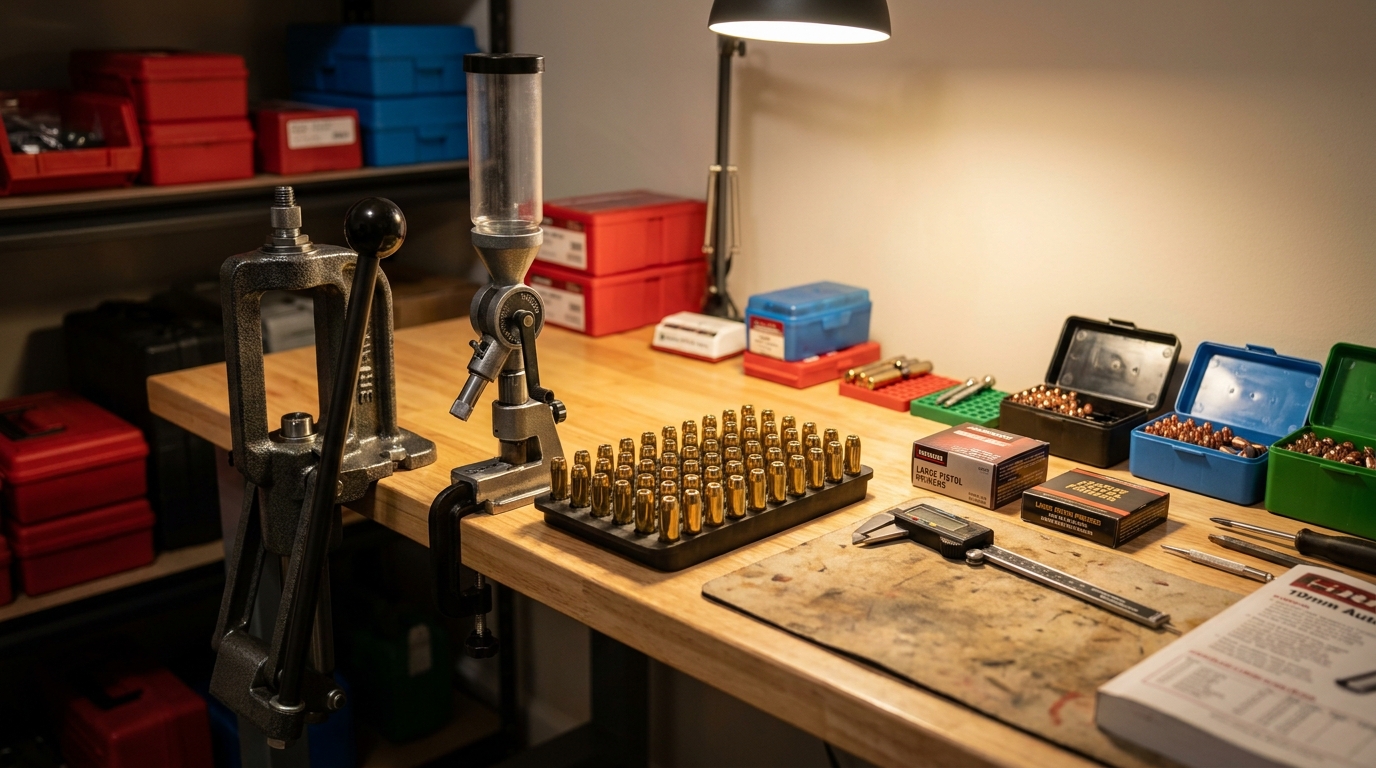
Dies: Standard carbide 3-die or 4-die sets from RCBS, Redding, Dillon, or Lee all work well. A carbide sizer die eliminates the need for case lube on straight-wall pistol brass — a time saver in high-volume loading. A taper crimp die is essential; 10mm uses a taper crimp (not a roll crimp) to headspace correctly on the case mouth.
Primers: Use large pistol primers for standard loads. For maximum-pressure hunting loads, some reloaders prefer large pistol magnum primers (CCI 350, Federal 155) to ensure reliable ignition with slower powders. Do not substitute small pistol primers — 10mm uses large primer pockets.
Powder Selection
Powder choice in 10mm has a big impact on velocity, pressure, and felt recoil. Here's a breakdown by use case:
- Alliant Power Pistol: The classic 10mm hunting powder. Relatively slow-burning for a pistol powder, it gets the most velocity from heavy bullets (180–200 gr) and is widely used in max-pressure hunting loads. Expect significant muzzle flash.
- Hodgdon Longshot: Similar burn rate to Power Pistol, slightly more consistent in cold weather. Excellent with 180–200 gr cast or jacketed bullets for hunting.
- Hodgdon CFE Pistol: A newer option that performs exceptionally across bullet weights and is cleaner-burning than Power Pistol. A great all-around 10mm powder.
- Alliant Blue Dot: Old-school but still effective with heavy bullets. Produces excellent velocity with 180 gr bullets and has been used in 10mm hunting loads for decades.
- Hodgdon Universal / Alliant Unique: Mid-burn powders for mid-weight bullets (155–165 gr) in range/target loads. Lower velocity but very consistent and affordable.
- Hodgdon Titegroup: For downloaded plinker loads and training ammo with 155–165 gr bullets. Very efficient, but don't use it near maximum 10mm pressures — it's a fast powder that can spike pressure quickly.
Load Data
All data from published Hodgdon, Alliant, and Hornady manuals. Always start 10% below maximum and work up carefully. Use a chronograph. Verify with a current published manual before loading.
155 gr FMJ / JHP — Range/Defense Load
- Powder: Hodgdon CFE Pistol | Start: 9.5 gr | Max: 11.5 gr | Velocity: ~1,300–1,400 fps (5" barrel)
- Powder: Alliant Power Pistol | Start: 8.5 gr | Max: 10.2 gr | Velocity: ~1,280–1,380 fps
- OAL: 1.250" | Primer: CCI 300 (LP) | Crimp: Taper, .422" case mouth
180 gr FMJ / JSP / Cast — Standard Load
- Powder: Alliant Power Pistol | Start: 7.8 gr | Max: 9.4 gr | Velocity: ~1,150–1,275 fps (5" barrel)
- Powder: Hodgdon Longshot | Start: 7.5 gr | Max: 9.2 gr | Velocity: ~1,130–1,260 fps
- OAL: 1.260" | Primer: CCI 300 or CCI 350 (magnum) | Crimp: Taper, .422"
200 gr Cast LSWC — Hunting Load
- Powder: Alliant Blue Dot | Start: 7.5 gr | Max: 9.0 gr | Velocity: ~1,050–1,175 fps (5" barrel)
- Powder: Hodgdon Longshot | Start: 7.0 gr | Max: 8.7 gr | Velocity: ~1,020–1,150 fps
- OAL: 1.250" | Primer: CCI 350 (LP Magnum) | Crimp: Taper, .422"
Bullet Selection by Application
For hunting deer and black bear: A 180–200 gr hard-cast lead flat-nose bullet at 1,200+ fps is the go-to. Hard-cast lead penetrates without expansion, which is what you want for deep penetration on heavy game. Buffalo Bore's hardcast loads inspired many handloaders to replicate them — and you can do it at a fraction of the factory cost. Cast Performance, Missouri Bullet Co., and Beartooth Bullets all make quality 10mm hunting bullets.
For backcountry bear defense: Same 200 gr hardcast load. Penetration over expansion is the priority. The 10mm loaded to full potential with a quality hardcast bullet generates ~500–530 ft-lbs of energy — adequate for deterrence against black bears and marginal grizzly deterrence at close range.
For defensive carry: A 155–165 gr JHP at 1,300+ fps is a serious fight-stopper. Hornady XTP, Speer Gold Dot, and Sierra JHPs all perform well in 10mm at these velocities. Premium JHPs designed for .40 S&W are engineered for lower velocity — 10mm-specific bullet designs that expand reliably at higher velocity are the right choice.
For target/USPSA/training: A downloaded 180 gr FMJ load with Titegroup or Unique at 1,050–1,100 fps is comfortable to shoot in volume and saves money over factory hardball.
Pressure Signs to Watch
The 10mm is unforgiving of sloppy technique. Watch for flattened primers, cratered primer pockets, stiff extraction, or brass that won't gauge properly. Because 10mm brass is straight-walled and relatively thin compared to rifle cartridges, case head separation is a risk in hot, heavily worked brass. Inspect cases carefully and retire any that show incipient case head separation (a bright ring near the base interior) or primer pocket loosening.
The 10mm Auto rewards careful reloading with performance that no factory load can match at the price. Whether you're packing into Oregon black bear country with a G20 or running competition stages, rolling your own is the way to unlock everything this cartridge has to offer.