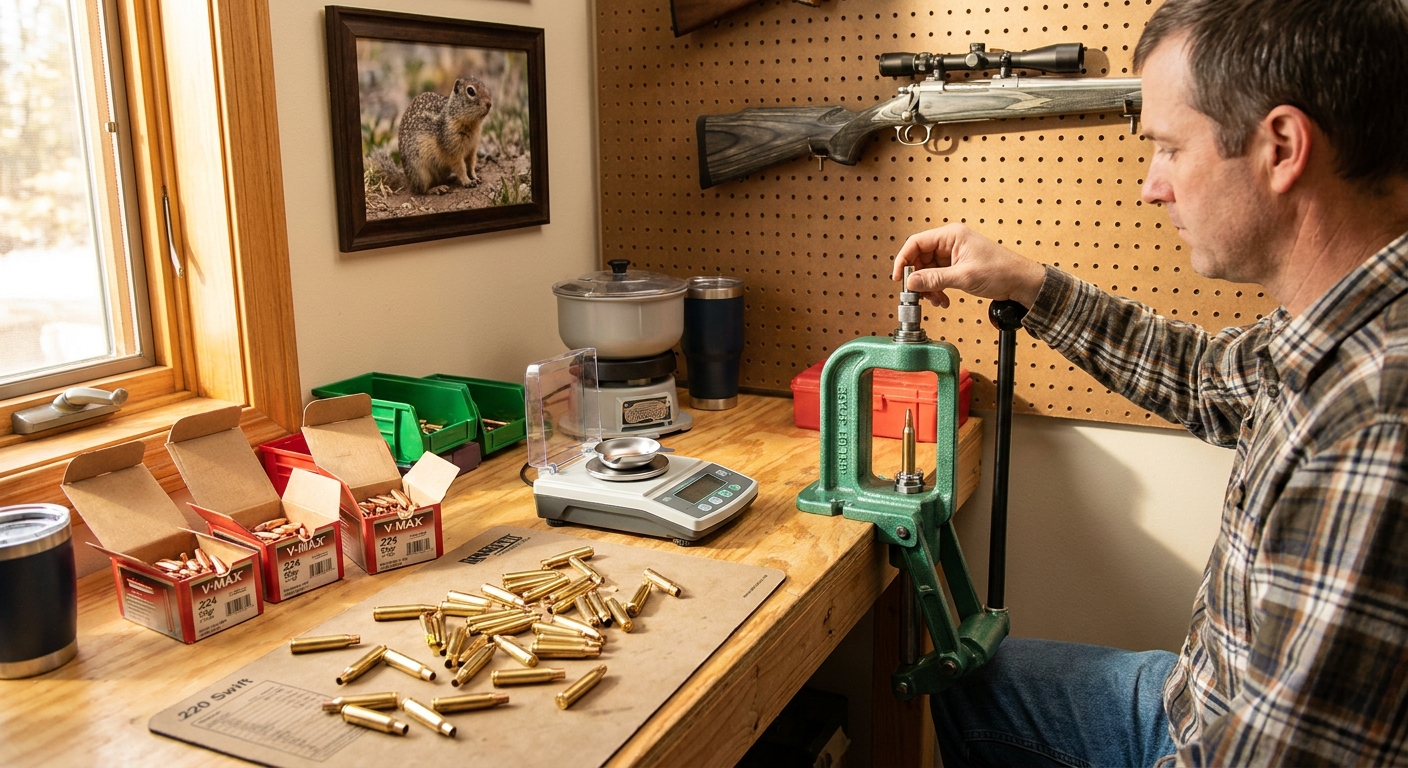
When Winchester introduced the .220 Swift in 1935, it became the first commercial cartridge to break 4,000 feet per second—a milestone that stood for decades. Nearly 90 years later, that velocity record still holds among factory-loaded commercial cartridges. The Swift has been overshadowed by the .22-250 Remington, the .204 Ruger, and a wave of modern PRC-era cartridges, but for dedicated varmint hunters in Oregon who want maximum reach and minimum wind drift on ground squirrel fields and coyote country, the .220 Swift remains a legitimate choice. The key is loading it right.
What Makes the .220 Swift Different
The Swift is based on a semi-rimmed case—an unusual design in modern cartridges—with a relatively large powder capacity for a .22 caliber. Its case holds roughly 45 grains of water by volume, more than the .22-250 (42 gr) or the .223 Remington (31 gr). That extra capacity is what makes factory loads in the 3,900–4,100 fps range possible with 50–55 grain bullets, and what makes handloading it such an interesting exercise in managing pressure and barrel heat.
The tradeoff is barrel life. The Swift is notoriously hard on barrels. A heavy varmint barrel in .220 Swift will typically last 2,000–3,500 rounds before accuracy degrades, compared to 5,000+ for a .223. For a serious varmint shooter running a squirrel field in June, that lifecycle goes by fast. Know this going in and plan your load to minimize unnecessary heat.
Case Selection and Preparation
Winchester and Nosler both produce quality .220 Swift brass. Lapua does not currently offer Swift cases, which puts it below its sibling cartridges in terms of top-tier brass options. For most varmint applications, Winchester brass is entirely adequate and affordable enough to replace regularly.
Prep Steps
- Full-length resize on every firing. The Swift headspaces on the rim, but the body still benefits from FL sizing to ensure reliable feeding and consistent headspace.
- Trim to length after 2–3 firings. Trim-to length is 2.195 inches; max SAAMI length is 2.205 inches. The Swift can grow quickly with hot loads.
- Check primer pockets for uniformity and clean them before each loading. Pocket depth variation affects ignition consistency.
- Neck turn for benchrest work if you're chasing maximum accuracy. For field varminting, it's unnecessary.
Powder Selection
This is where Swift reloading gets interesting. The large case needs a powder fast enough to fill it efficiently without exceeding pressure limits, but not so fast that it produces excessive peak pressure before the bullet is well down the bore. Medium-to-medium-slow powders in the Hodgdon H4895 to IMR-4064 speed range are the traditional sweet spot.
Top Powder Choices
- Hodgdon H380: The original Swift powder, literally developed for the cartridge by Bruce Hodgdon using the .220 Swift as his test platform. Still excellent. With 52–55 grain bullets, H380 routinely produces top velocities at safe pressures. Start at 38.0 gr and work up carefully to a maximum near 40.0 gr with 52 gr bullets (per current Hodgdon data).
- IMR-4064: Slightly temperature sensitive but produces excellent accuracy nodes with 50–55 grain bullets. Meters well through a powder measure.
- Varget: Temperature-stable and widely available. Slightly faster burn rate than H380 means slightly lower top-end velocities, but excellent case fill and consistent ignition across temperature ranges—useful for Oregon shooters moving between cool coastal mornings and hot high-desert afternoons.
- Hodgdon H4895: Works well with heavier 60–70 grain bullets if you want to push the Swift into coyote territory with more retained energy at distance.
Bullet Selection for Oregon Varmint Hunting
The .220 Swift shines with light, frangible bullets at high velocity for ground squirrel work, but it can also handle heavier projectiles for coyotes and foxes.
- 40 gr Hornady V-MAX: Screaming fast—4,000+ fps is achievable—with explosive terminal performance on small varmints. Wind drift is real at this weight; limit your distance to 400 yards in any breeze.
- 50 gr Nosler Ballistic Tip or Hornady V-MAX: The sweet spot for most Swift shooters. High BC relative to bullet weight, very flat trajectory, excellent fragmentation. The Swift genuinely reaches out to 500+ yards on squirrels with this combination.
- 52–53 gr match-style HP (Sierra MatchKing, Berger): If you want raw accuracy rather than explosive terminal performance, these match hollow points shoot sub-half-MOA in a quality Swift barrel and are excellent for long-range varminting.
- 60 gr Hornady SP or Nosler Partition: For coyotes where you want more retained weight and less meat destruction. Velocity drops, but the Swift with a 60-grainer still clocks 3,600+ fps at the muzzle.
Sample Starting Loads (Always Verify Against Current Published Data)
Note: The following are reference ranges based on published reloading manuals. Always begin 10% below maximum and work up in increments, watching for pressure signs.
- 50 gr V-MAX + 38.0 gr H380 + Winchester LR primer: ~3,850 fps, excellent accuracy potential
- 52 gr HPBT + 37.5 gr Varget + CCI BR2 primer: ~3,750 fps, high consistency
- 55 gr Nosler BT + 36.5 gr IMR-4064 + Federal 210M primer: ~3,700 fps, all-around coyote load
Pressure Signs to Watch
The Swift runs hot. With maximum loads you're operating near the edge of what brass and primers can safely handle. Watch for:
- Flattened or cratered primers
- Sticky bolt lift or difficult extraction
- Ejector swipe marks on the case head
- Primer pocket loosening after only 2–3 firings
Any of these means you're over pressure. Back off 1.0–1.5 grains immediately and retest. The Swift will reach its velocity potential before it reaches a safe maximum in many loading combinations.
Managing Barrel Heat in the Field
On a ground squirrel field where you might fire 30–50 rounds per hour, barrel heat management is critical. Let the barrel cool between strings—five shots, then a 3–5 minute break minimum. A carbon fiber or heavy stainless varmint barrel helps extend your shooting windows. Barrel-mounted cooling fans exist and actually work if you're shooting from a bench at a set location.
Is the .220 Swift Worth It?
For the Oregon varmint hunter who wants flat trajectory, minimal wind drift, and the ability to reach out to 500+ yards on ground squirrels in the high desert east of Bend or the fields around Prineville and Burns—yes, absolutely. It requires more reloading attention than a .223 and it will eat barrels, but the performance at distance is genuine and the cartridge has earned its century-long reputation. Load it carefully, give it a quality barrel, and the .220 Swift still delivers what it promised in 1935: more velocity than anything else in a .22-caliber case.