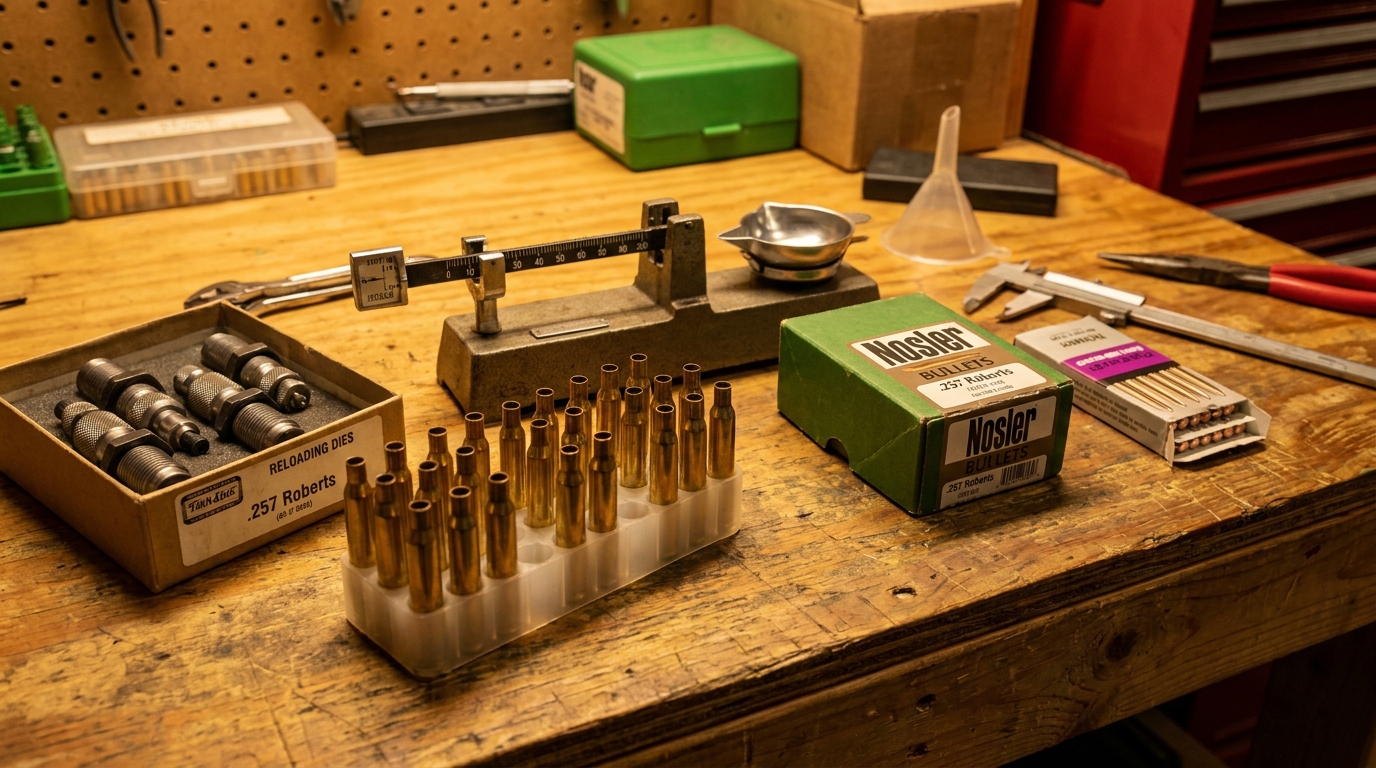
The .257 Roberts is one of those cartridges that never quite got the recognition it deserved. Introduced in 1934 and based on a necked-down 7x57 Mauser case, the Bob — as its fans call it — sits in a performance window that is almost perfectly suited to deer, pronghorn, and Columbia blacktail hunting. It is mild to shoot, accurate, efficient with powder, and capable of excellent terminal performance with quality projectiles.
The problem is ammunition. Factory .257 Roberts loads are limited, and some of what's available is loaded to conservative pressures due to older rifles. The solution, as it so often is with overlooked cartridges, is the handloading bench. Reload the .257 Roberts and you open up its full potential — and that potential is considerable.
Case Selection and Prep
Starline and Hornady both offer quality .257 Roberts brass. Remington and Federal headstamped cases are available but tend to be thicker, which can affect powder capacity slightly. For a deer and pronghorn rifle you'll shoot a few hundred rounds a year, any major-brand brass will serve well.
Trim length is 2.228 inches (trim-to length). Brass will grow with firing, so check and trim after every two to three firing cycles. Use a VLD chamfering tool to clean up the case mouth inside and out — the .257 diameter is finicky about bullet seating if the case mouth has burrs.
Full-length resize for hunting loads used in a bolt gun. Neck-size only if you're loading for a single rifle and focused on benchrest-level precision. Depriming and repriming with standard large rifle primers is straightforward — this is a conventional rimless case with nothing unusual in its dimensions.
Primer Selection
The .257 Roberts responds well to standard large rifle primers. Federal 210M (match) primers are excellent for accuracy-focused loads. CCI 200 and Winchester WLR are reliable and widely available. Magnum primers are not necessary and can push pressures higher than you want in a cartridge that already operates comfortably below its SAAMI maximum. Stick with standard LR primers unless load data specifically recommends magnum.
Powder Choices
The .257 Roberts case volume and operating pressure make it well-suited to medium-speed rifle powders in the 4350-4831 burn rate range. Here are the top performers:
- IMR 4350 — The go-to powder for the .257 Roberts for decades. Meters well, is widely available, and delivers excellent velocity with 100–117 grain bullets. Start 3 grains below listed max and work up carefully.
- H4831SC — Outstanding for 115–120 grain loads. The short-cut version meters more accurately than regular H4831. Excellent temperature stability makes it a strong choice for hunting cartridges used in variable weather.
- Reloder 22 — Gives a velocity edge with heavier bullets (115–120 grain). Excellent accuracy potential. Slightly temperature-sensitive compared to H4831.
- IMR 4831 — Slightly slower than IMR 4350, pairs well with 117–120 grain bullets. Classic pairing with this cartridge.
- Varget — Works well with lighter bullets (75–90 grain) for varmint applications. A bit fast for the heavier deer weights but worth knowing about if you use the .257 Roberts as a dual-purpose rifle.
Bullet Selection
The .257-caliber bullet selection is outstanding, and this is where the .257 Roberts really shines for handloaders who can take advantage of it.
Deer and Blacktail (100–110 grain)
- Nosler 100-grain Partition — The benchmark premium deer bullet in .257. Controlled expansion, excellent penetration, reliable performance at Roberts velocities. Load this one for Coast Range blacktail and Cascade deer.
- Sierra 100-grain GameKing — A classic controlled-expansion bullet that shoots flat and opens well at moderate velocities. Economical choice for general hunting.
- Hornady 100-grain InterBond — Bonded core design for excellent weight retention. Good option for larger deer and shots at closer ranges in timber.
Pronghorn (87–100 grain)
- Hornady 87-grain V-MAX or 90-grain ELD-X — Fast and flat for open-country antelope work. The 87-grain V-MAX is devastating on pronghorn at any practical range.
- Berger 95-grain Classic Hunter — Excellent BC for extended range, opens reliably. A strong choice for antelope past 300 yards from a well-tuned .257 Roberts.
Dual-Purpose Varmint/Deer (75–87 grain)
- Sierra 75-grain HP or Hornady 75-grain V-MAX — Ground squirrel and coyote loads that really showcase the Roberts' flat trajectory. Push these to 3,300+ fps for impressive performance at distance.
Sample Starting Loads
Note: Always begin at the starting charge listed in a current reloading manual and work up carefully. These are reference points, not prescriptions. Verify against Lyman, Hornady, or Nosler current data.
- Nosler 100 Partition / IMR 4350 / 43.0 gr start / ~2,850 fps (work to max per manual)
- Sierra 100 GameKing / H4831SC / 44.0 gr start / ~2,870 fps
- Hornady 87 V-MAX / IMR 4350 / 44.5 gr start / ~3,050 fps
- Berger 95 Classic Hunter / Reloder 22 / 44.0 gr start / ~2,950 fps
Accuracy Expectations
A quality .257 Roberts rifle — Ruger 77, Winchester Model 70, or a custom rifle — will shoot sub-MOA with the right handload. Plan to test at least three to four powder charge levels across two or three seating depths before settling on a hunting load. The .257 Roberts is an inherently accurate cartridge; finding its sweet spot is satisfying benchwork.
Don't let the .257 Roberts' obscurity fool you. Handloaders who take the time to develop quality loads in this chambering end up with one of the most balanced all-around western hunting cartridges on the shelf. Mild recoil, excellent accuracy, and enough horsepower for anything in Oregon's fields and hills. The Bob has always delivered. It just never had a good publicist.