Why the .357 Magnum Deserves a Spot on Your Loading Bench
The .357 Magnum turned 90 years old recently, and it hasn't lost a step. Developed in 1935 as a law enforcement round with serious stopping power, it's become one of the most popular handgun cartridges in American history — and one of the most rewarding to handload. The combination of wide bullet selection, forgiving brass, and the ability to shoot .38 Special loads through the same firearm makes the .357 uniquely versatile. Whether you're loading mild 148-grain wadcutters for practice or stout 180-grain hard-cast loads for deer season, the same dies and the same press get you there.
Equipment You'll Need
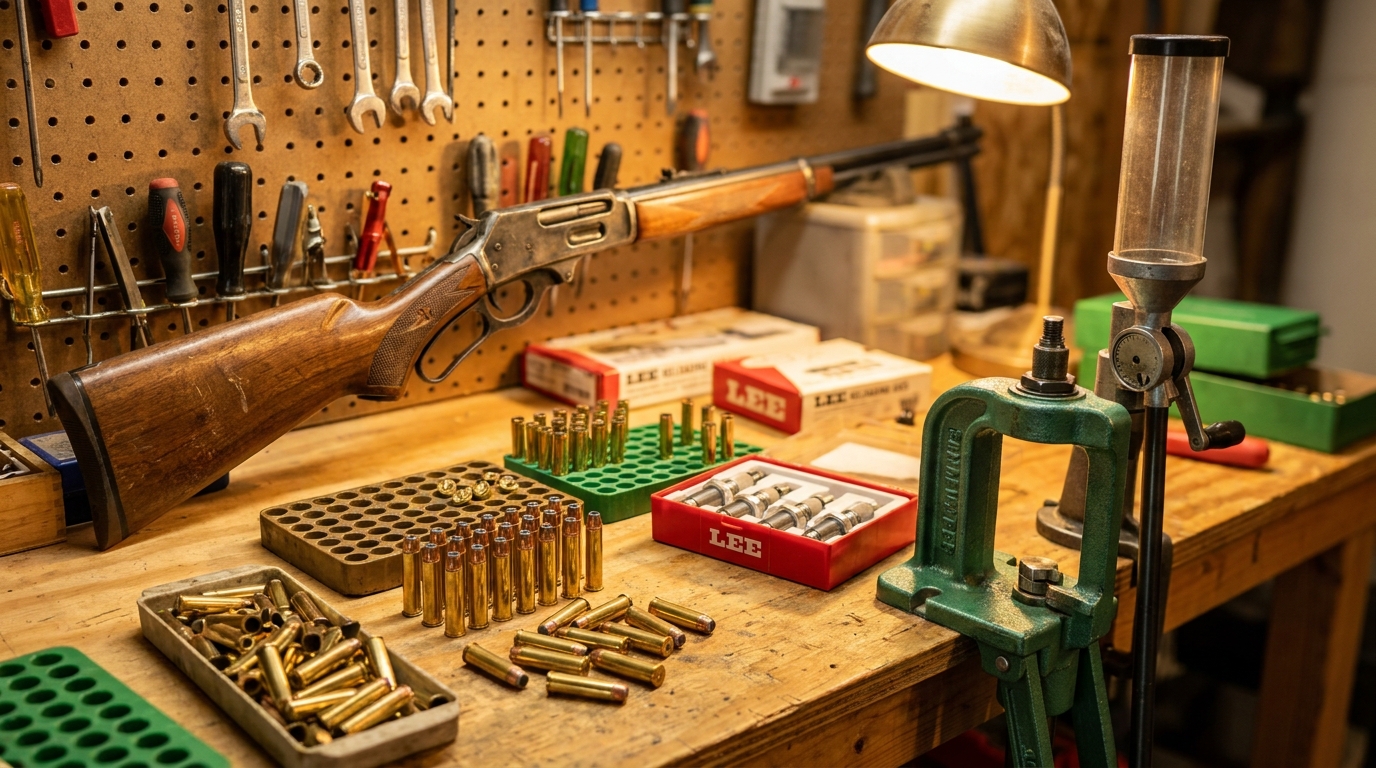
- Dies: Full-length sizing/decapping die, powder-through expander/flare die, seating die, crimping die (or combination seat/crimp). RCBS, Redding, and Lee all make quality .357 dies.
- Brass: .357 Magnum brass from Starline, Hornady, or Remington. Avoid cheap mixed headstamp brass for serious hunting loads — consistency matters.
- Primers: Large pistol primers for standard loads; large pistol magnum primers for maximum charges with slow powders or long bullets.
- Powder measure and scale
- Calipers — for checking OAL
Brass Preparation
.357 Magnum brass is tough and long-lived. After decapping and sizing, clean primer pockets and inspect for case head separation, cracks at the case mouth, and bulges. .357 brass doesn't need trimming as often as rifle cases, but after 10–15 loadings it's worth checking case length against published maximums (1.290" for .357 Mag). Flaring the case mouth slightly prevents shaving lead from the bullet as it enters the seating die.
The Taper Crimp vs. Roll Crimp Question
For revolvers, always use a roll crimp — the case mouth crimps into the bullet's cannelure, which prevents bullet pull under recoil and ensures reliable feeding through the cylinder. For lever-action rifles, a firm roll crimp is even more important because the feeding process can cause seated bullets to shift under recoil in the magazine tube. Never skip the crimp on .357 hunting loads.
Bullet Selection
For Practice and Plinking
- 125–140 grain lead round nose or SWC — Cast or swaged lead bullets at mild velocities are cheap and easy on the barrel.
- 158 grain lead SWC — The classic .357 bullet weight. Accurate, well-balanced, and effective for anything short of big game.
For Deer and Hogs
- 158 grain JSP (Jacketed Soft Point) — Sierra, Hornady, and Speer all offer quality 158-grain JSPs that expand well at .357 velocities from both handguns and lever guns.
- 158–180 grain hard cast flat nose — Buffalo Bore, Cast Performance, and many custom casters make excellent hard-cast bullets for penetration on deer and hogs. Better for lever guns due to tube magazine safety.
- 180 grain XTP (Hornady) — A heavier, controlled-expansion bullet that performs well from lever-action rifles at extended ranges.
Powder Selection and Load Data
The .357 Magnum works well with a wide range of powders. Here are proven performers:
Fast to Medium Burn Rate (Best for Handguns)
- Hodgdon Longshot: 9.5–11.0 grains under a 158-grain JSP produces 1,250–1,400 fps from a 6" revolver. Excellent flash suppression and consistent ignition.
- Alliant 2400: A classic .357 powder. 13.0–15.0 grains under a 158-grain bullet yields excellent velocity with good case fill. Slightly sooty but very consistent.
- Hodgdon H110/Winchester 296: Requires magnum primers and should be loaded to near maximum. 16.0–17.5 grains under a 158-grain JSP produces maximum velocity, approaching 1,450 fps from a 6" barrel.
Slower Powders (Better for Lever-Action Rifles)
- Hodgdon Lil' Gun: 17.0–19.0 grains under 158-grain bullets extracts extra velocity from the longer lever-gun barrel — expect 1,700–1,800 fps from an 18" rifle. This is where the .357 Magnum transitions from handgun caliber to legitimate deer medicine.
Always consult current published load data from Hodgdon, Hornady, Lyman, or your powder manufacturer before loading. Never exceed maximum listed charges. Start at the minimum and work up while watching for pressure signs.
OAL and Crimping
Overall length (OAL) varies by bullet design but typically runs 1.575" to 1.590" for 158-grain bullets in .357 Magnum. Seat to the bullet's crimp groove and apply a firm roll crimp. Check OAL on every tenth round or so — seating consistency directly affects pressure and accuracy.
The Lever-Gun Advantage
One of the best things about reloading .357 Magnum is what happens when you run it through a lever-action rifle. With an 18–20" barrel, the cartridge approaches .30-30 performance levels. A 158-grain JSP at 1,750 fps from a Marlin 1894 or Henry Big Boy is entirely adequate for whitetail deer and black bear at woods ranges. It's light, handy, fun to shoot, and makes a tremendous camp gun. And with handloads, you control the velocity, bullet, and performance characteristics completely. The .357 Magnum is proof that great cartridges don't expire. Load it right, and it'll take care of you whether you're poking holes in paper or filling a deer tag.