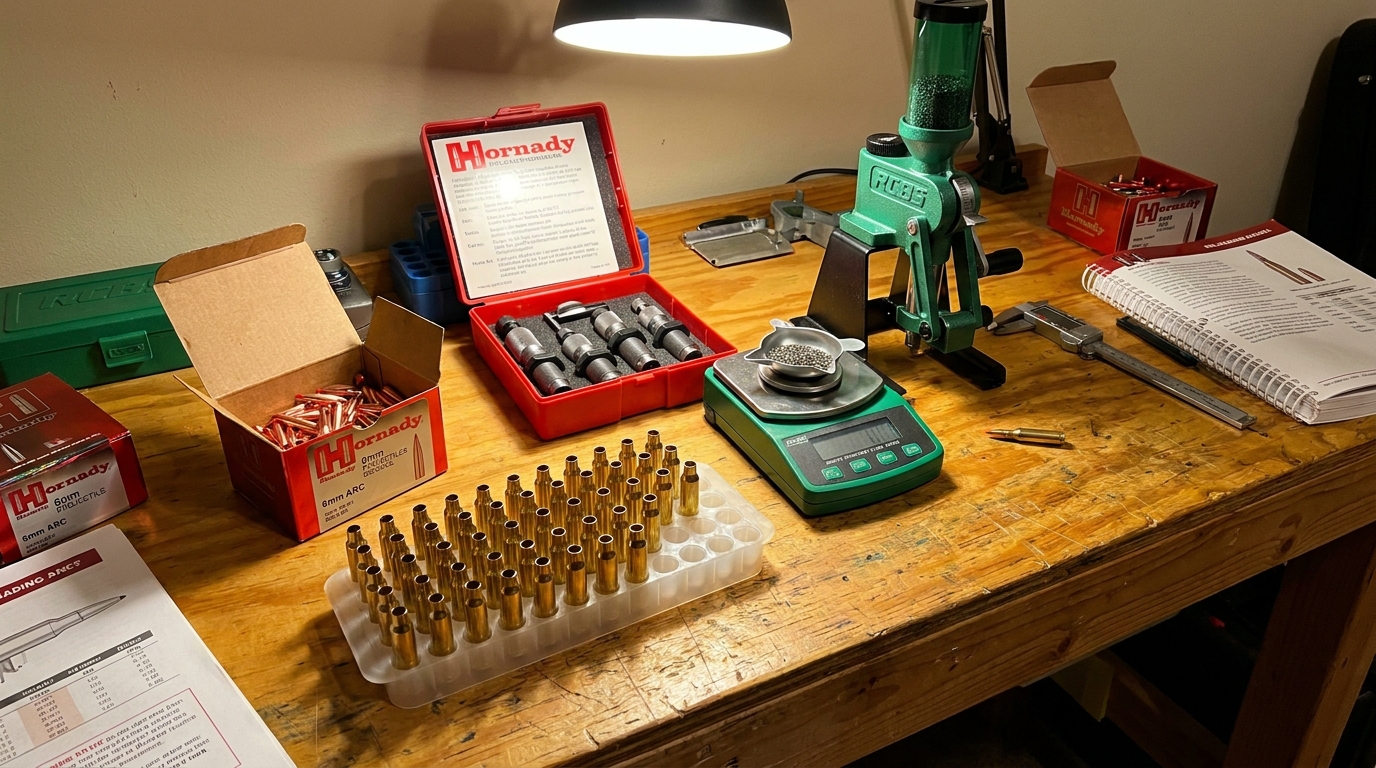
When Hornady introduced the 6mm ARC (Advanced Rifle Cartridge) in 2020, the reaction from the shooting community was predictably split — some dismissed it as a solution to a problem that didn't exist, while others recognized it immediately for what it is: a serious precision hunting cartridge optimized for the AR-15 platform. Three years of field use have largely settled the debate. The 6mm ARC is a legitimate performer, and it handloads exceptionally well.
Why the 6mm ARC?
The 6mm ARC was designed to push high-BC 6mm projectiles — think 103-grain ELD-X, 108-grain ELD Match — at velocities that exploit their aerodynamic advantages at long range, all from a cartridge that fits in a standard STANAG AR-15 magazine and runs in a standard bolt-face AR platform.
Compared to the .223 Remington, the 6mm ARC delivers dramatically better wind drift and retained energy at distances beyond 400 yards. Compared to the 6.5 Grendel, it's slightly more efficient with a better selection of high-BC projectiles. Compared to the 6.5 Creedmoor, you sacrifice roughly 150–200 fps, but you gain everything that comes with an AR-15 platform — detachable box magazines, semi-auto operation, and a short, lightweight rifle.
For Oregon deer hunting — where most shots in the timber are under 200 yards but you might need to reach out to 400+ in open high desert — the 6mm ARC is a genuinely useful tool.
Brass
Quality brass is the foundation of accurate handloads, and 6mm ARC brass is sourced from just a few manufacturers right now. Your primary options:
- Hornady: The original and most widely available. Consistent weight and dimensions, good neck tension, and it lasts through multiple firings with proper annealing after 3–4 loadings
- Lapua: Released in 2022, Lapua 6mm ARC brass is the premium choice. Tighter tolerances, longer case life, and superior uniformity. Worth the premium for a precision-oriented cartridge
After sizing and before your first handload, sort brass by weight and trim all cases to 1.490 inches (SAAMI max is 1.500"). Deburr and chamfer the case mouth. If you're annealing, do it after every third or fourth firing. The 6mm ARC's modest capacity rewards consistent brass prep.
Primers
Use small rifle primers — the 6mm ARC runs on small rifle, not small pistol. For hunting and precision work, Federal 205M Gold Medal Match and CCI BR4 are both excellent. The match primers' more consistent ignition characteristics show up as lower standard deviations in velocity, which matters at extended range. For volume practice loads, standard CCI 400 or Remington 7.5 primers are fine.
Note: Some shooters use small rifle magnum primers with slower powders. Test both in your specific rifle — the differences are typically small but can affect node behavior in load development.
Powder Selection
The 6mm ARC's case capacity sits around 34–35 grains of water. It's a mid-small case that performs best with medium-burn-rate powders:
- Hodgdon CFE 223: The top performer in most 6mm ARC load development. Excellent velocity, low fouling, and superb accuracy with 103- to 108-grain bullets. Start at 27.0 grains, work up to 29.5 grains. Expect 2,580–2,650 fps with 103-grain ELD-X from a 24-inch barrel
- Hodgdon Varget: The classic precision powder that works nearly everywhere it fits. Consistent across temperature extremes — important for hunting applications where you might load in summer for a fall hunt. 26.5–28.5 grains with 103-grain bullets. Slightly lower velocity than CFE 223 but extremely predictable
- Alliant Power Pro 2000-MR: Worth exploring if you're optimizing for the 108-grain ELD Match. Burns clean in gas-operated platforms and shows excellent accuracy potential. Start around 26.0 grains
- Hodgdon H4350: A bit slow for the 6mm ARC's case capacity, but some shooters report excellent accuracy with 90- to 95-grain bullets. Less ideal for heavier projectiles
Always start 10% below maximum published data and work up in 0.3-grain increments, watching for pressure signs at each step.
Bullet Selection
The whole point of the 6mm ARC is running high-BC 6mm projectiles. Your primary hunting choices:
- Hornady 103-grain ELD-X: The go-to hunting bullet. G1 BC of 0.512, reliable terminal performance from 2,000 fps down through 1,600 fps, and excellent accuracy potential. This is what the cartridge was optimized around — start here
- Nosler 90-grain AccuBond: For closer-range deer work or if you're pushing velocity, the 90-grain AccuBond expands reliably and penetrates well. Works beautifully in the 6mm ARC
- Berger 105-grain Hybrid Target: Strictly for long-range shooting — fragile construction limits hunting use, but ballistically exceptional. G7 BC of 0.264
- Sierra 107-grain MatchKing: Match bullet, but many deer hunters use it at reasonable ranges with good results due to its thin jacket and high velocity retention
Proven Load Data
These loads have produced sub-MOA accuracy in multiple 6mm ARC rifles with 24-inch barrels. Always verify against current published data from Hodgdon, Hornady, or Berger, and work up from the starting charge in your specific rifle:
- 103-gr ELD-X / CFE 223 / 28.8 gr / CCI 400: ~2,640 fps, ES <25 fps. Excellent hunting load
- 103-gr ELD-X / Varget / 27.8 gr / Federal 205M: ~2,580 fps, ES <18 fps. Temperature-stable hunting load
- 108-gr ELD Match / CFE 223 / 28.4 gr / CCI BR4: ~2,590 fps, ES <20 fps. Precision target and extended-range work
OAL and Seating Depth
The 6mm ARC has a short throat optimized for high-BC bullets with their long ogives. For the 103-grain ELD-X, COAL of 2.260 inches typically puts you 0.010–0.015 inches off the lands in Hornady-spec chambers. Seat to magazine length (2.260") and you'll be very close to an ideal seating depth for most rifles. Use a Hornady OAL Gauge to measure your specific chamber if you're chasing the last bit of accuracy.
Final Notes
The 6mm ARC rewards careful, methodical loading. It's not a forgiving cartridge that shoots everything well — but when you find its node, it delivers honest sub-MOA accuracy that makes it genuinely useful at the ranges its ballistics support. Load development typically runs 5–6 sessions to nail a final hunting load. Do the work on paper before the season, and you'll have a hard-hitting, flat-shooting deer rifle in an AR platform that would surprise most hunters who've never looked past the .223 and 6.5 Grendel.