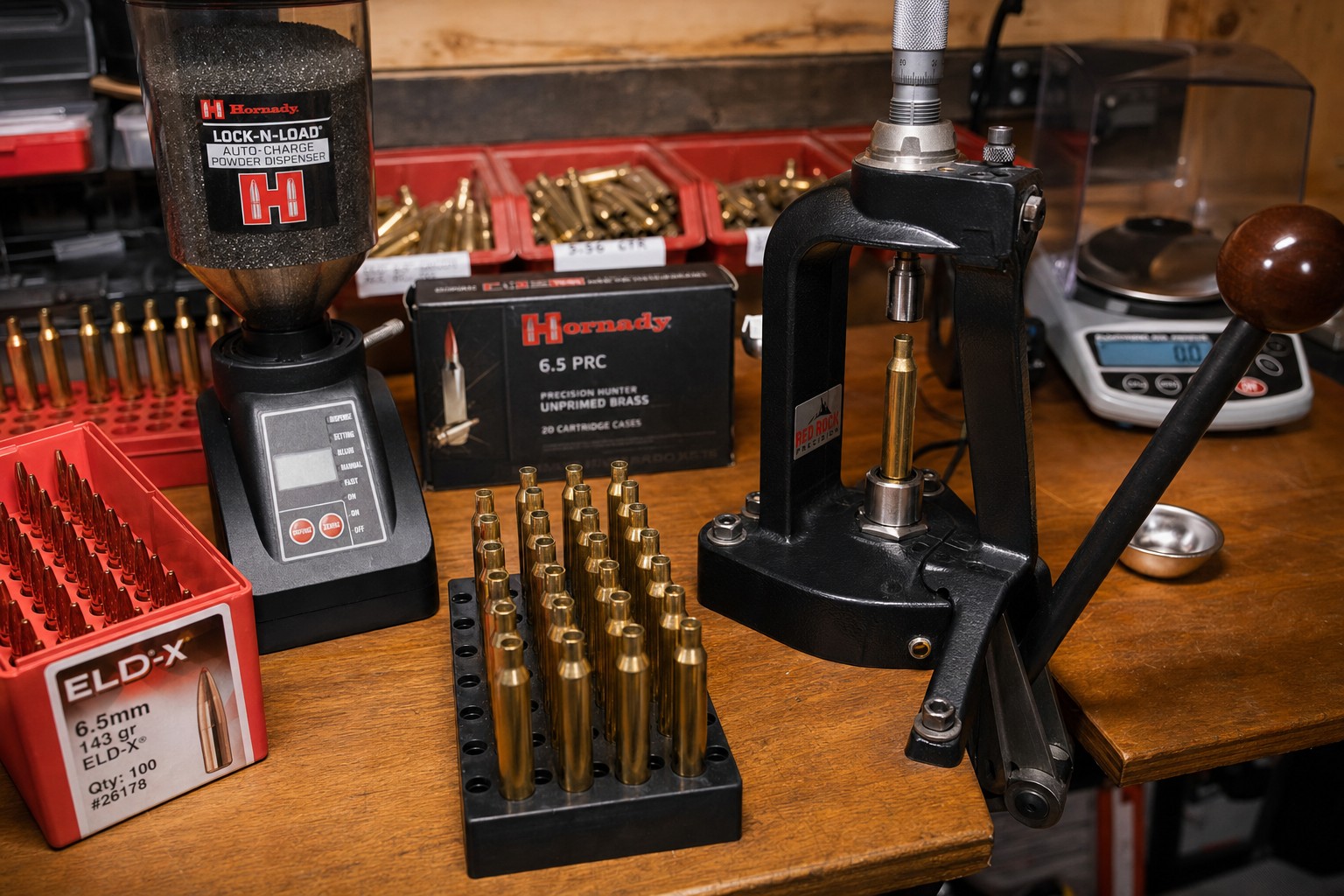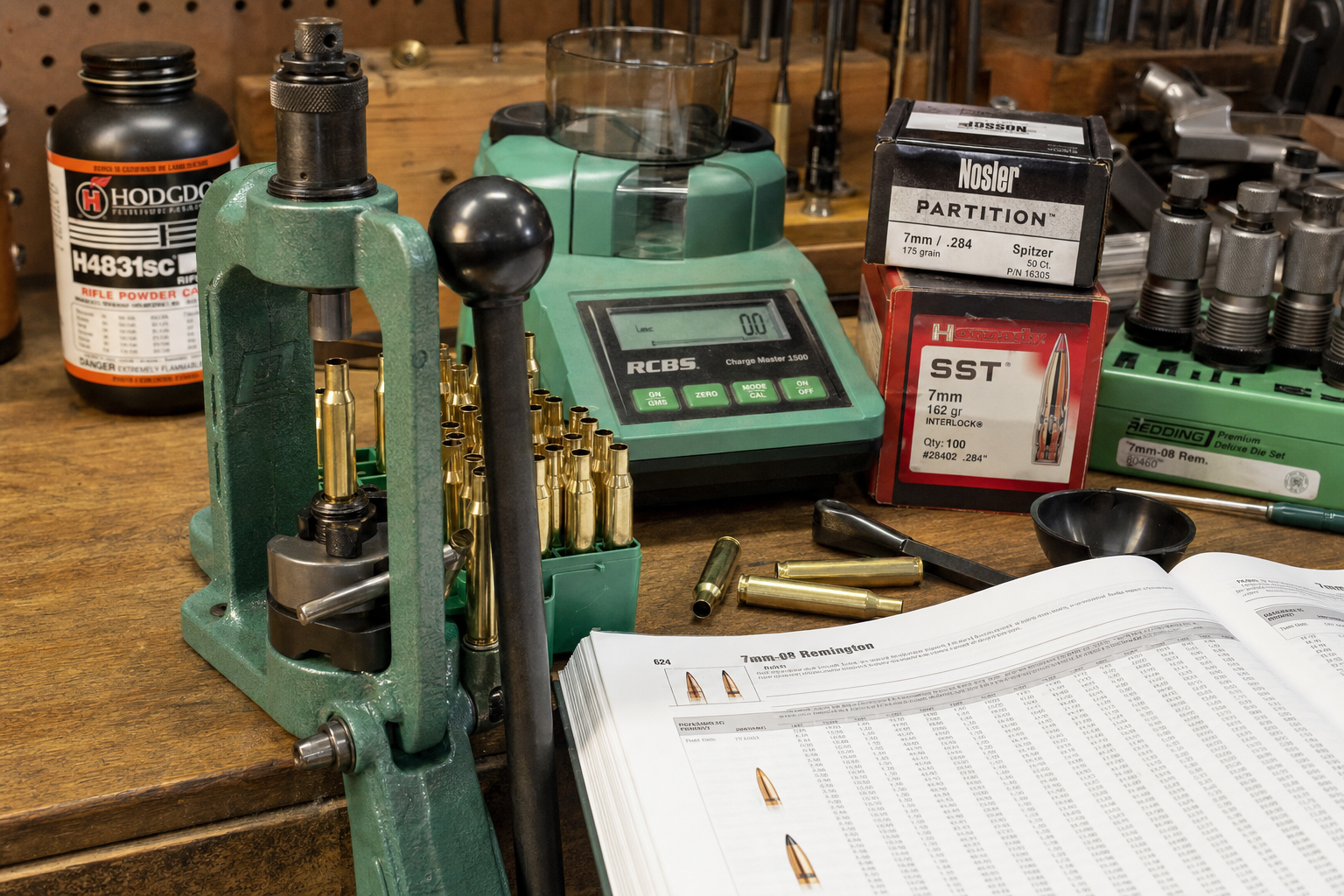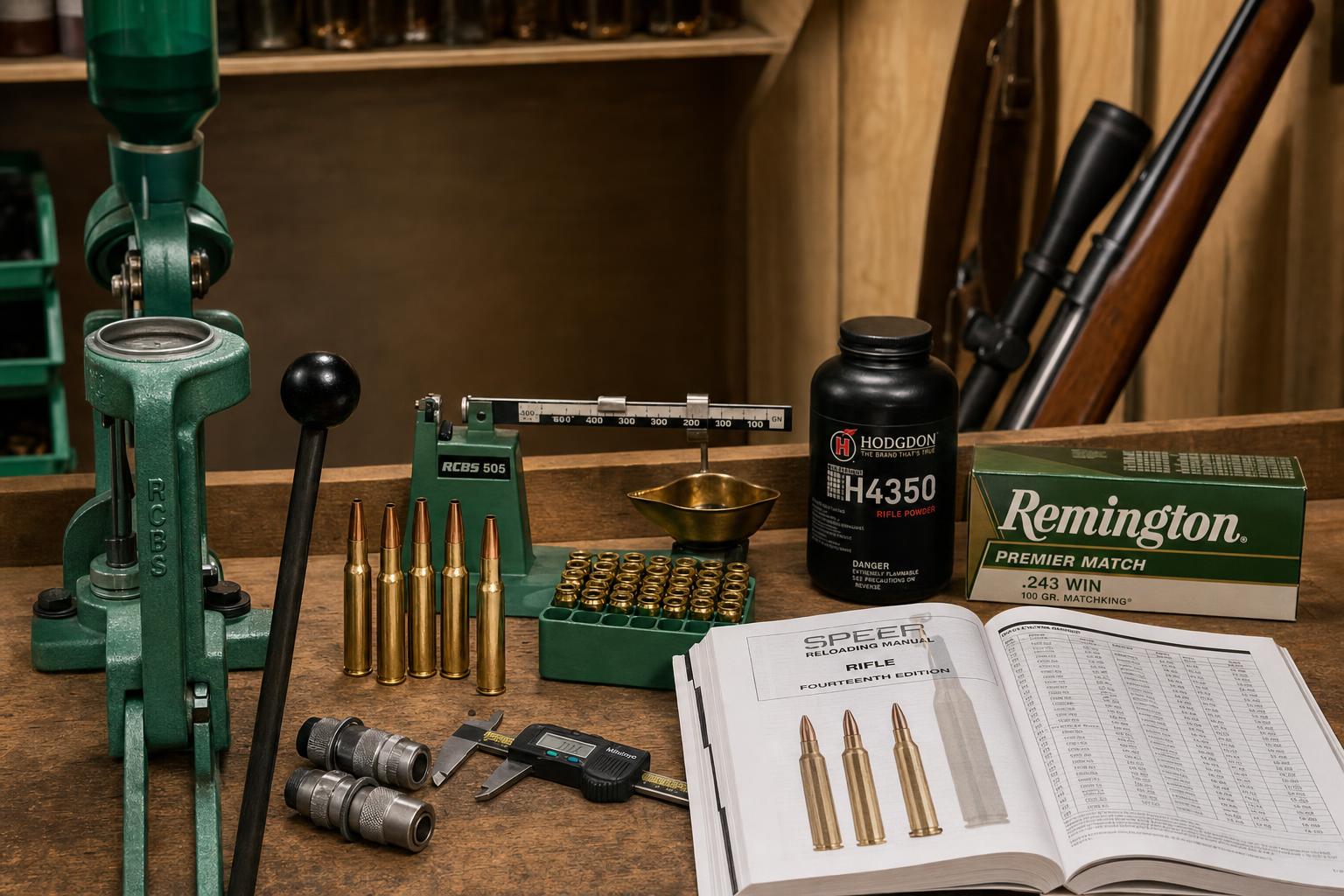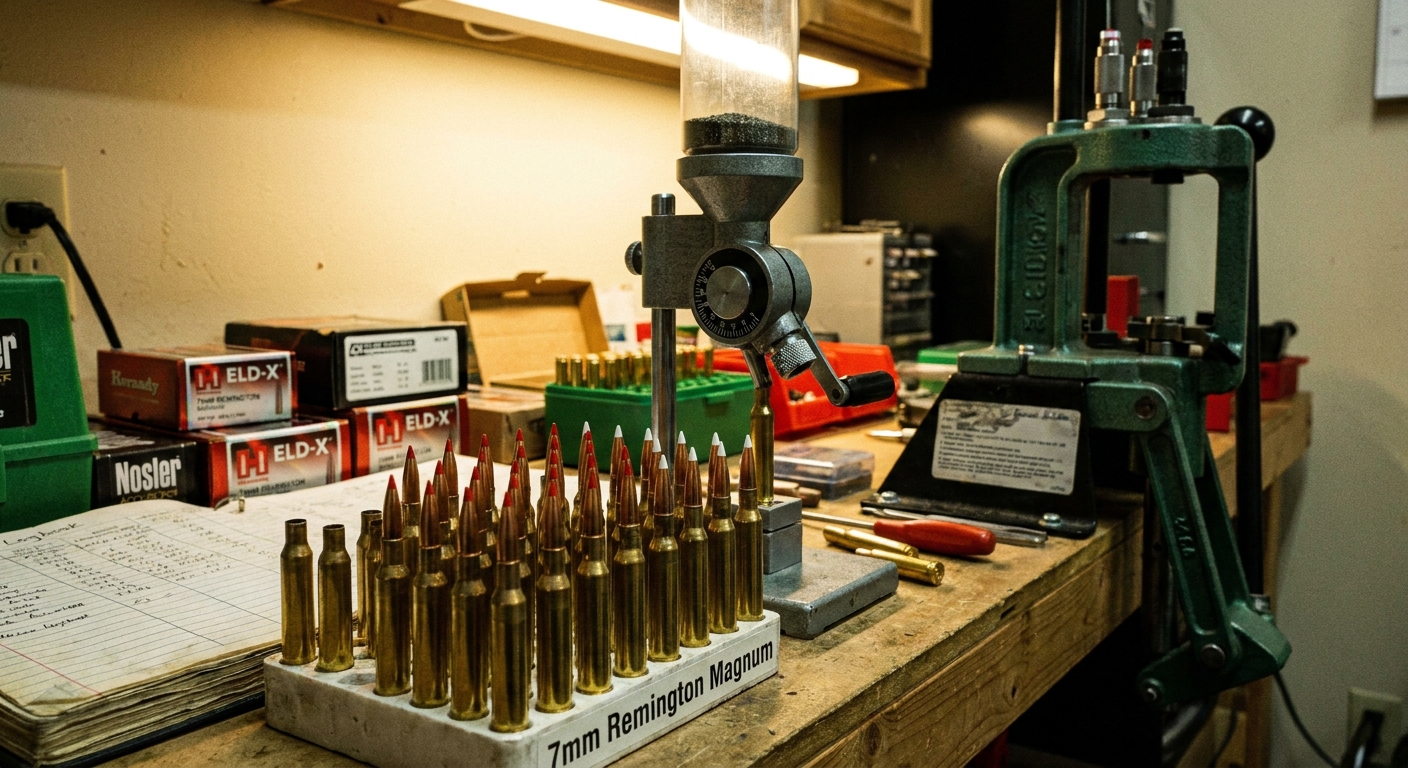
The 7mm Remington Magnum has been putting elk on the ground in Oregon and across the West since Remington introduced it in 1962. It is flat-shooting, hard-hitting, and available in more factory loads and reloading components than almost any other magnum cartridge on the market. For handloaders, it rewards careful work with accuracy and terminal performance that factory ammunition rarely delivers at the same price point. This guide covers the components, powders, and load data to build a premium 7mm Rem Mag elk load from scratch.
Case Prep and Brass Selection
The 7mm Rem Mag runs on a belted magnum case. The belt is technically a headspacing surface, though in practice most rifles headspace on the shoulder. This means fire-formed brass can develop excessive headspace if you full-length resize aggressively on every firing. The solution for longevity is to neck-size only for the first several firings after fire-forming, then full-length resize with a small-base die when the case no longer chambers freely.
Top brass choices for the 7mm Rem Mag:
- Nosler: Consistent wall thickness and excellent weight uniformity out of the box. A premium choice that typically requires minimal prep.
- Federal Gold Medal: Uniform primer pockets and excellent neck tension. Widely available.
- Remington: Functional and affordable, but benefits from annealing sooner than premium brass due to harder neck hardness from the factory.
- Winchester: A solid mid-tier option. Slightly heavier than Nosler or Federal, which slightly reduces powder capacity, but consistent.
Standard prep steps: trim to 2.490 inches (max length is 2.500 inches), deburr and chamfer case mouths, uniform primer pockets, and anneal necks every 2 to 3 firings for maximum consistency.
Primer Selection
The 7mm Rem Mag uses a large rifle magnum primer. For slower powders filling large case volumes, consistent ignition is critical.
- Federal 215M (Gold Medal Match): The gold standard for large rifle magnum applications. Highly consistent and widely trusted by precision reloaders.
- CCI 250: Reliable and hard-cup construction resists slam-fires. Slightly hotter than the Federal 215M, which can marginally increase velocity and pressure.
- Remington 9.5M: A quality option and widely available. Performs consistently across a range of powder charges.
Avoid substituting standard large rifle primers in a magnum case. The larger powder charge and slower burn rate of magnum powders require the hotter spark of a magnum primer for reliable, complete ignition.
Powder Selection
The 7mm Rem Mag operates in a medium-large case volume with a long-for-caliber bullet seated deep. Slow-burning powders that fill the case well and meter cleanly are the sweet spot.
- Hodgdon H4831SC (short cut): The most popular powder for the 7mm Rem Mag and for good reason. Fills the case well, meters exceptionally, and produces excellent velocity and accuracy with 160 to 175-grain bullets. Temperature stable enough for hunting applications.
- IMR 4831: The original magnum powder and still excellent. Slightly faster burning than H4831SC, works best with 140 to 160-grain bullets for peak velocity.
- Reloader 22 (Alliant): Slower than H4831SC, excellent with heavy 168 to 175-grain bullets. Produces the highest velocities in the 7mm Rem Mag case of any commonly available powder and handles cold-weather hunting conditions well.
- Hodgdon Retumbo: The slowest option here. Best paired with the heaviest bullets in the caliber (175-grain and up). Less common but worth trying if you are building a dedicated long-range elk load with a 175-grain ELD-X.
- IMR 7828 SSC: A strong performer across bullet weights from 140 to 175 grains. Short-cut version meters well and fills the large case efficiently.
Bullet Selection for Elk
Elk are large, tough animals. For a cartridge like the 7mm Rem Mag, the standard advice to use bonded or controlled-expansion bullets at hunting velocities is well-founded.
- Nosler 160gr AccuBond: The most versatile elk bullet for this cartridge. Bonded construction retains weight well at impact velocities ranging from 200 to 600 yards. Excellent BC (around .531) for a hunting bullet and proven terminal performance on elk in Oregon and throughout the West.
- Hornady 162gr ELD-X: Outstanding BC (.631 G1) and the Heat Shield tip resists deformation in the magazine. The ELD-X expands reliably at reduced impact velocities common on long shots past 400 yards and fragments aggressively on close-range hits through the zone without blowing up. An excellent all-distance elk bullet.
- Swift 160gr A-Frame: The controlled-expansion standard for dangerous game and tough-angle elk shots. Penetration is exceptional and weight retention often exceeds 95 percent. The trade-off is a lower BC than the AccuBond or ELD-X, making trajectory more curved past 300 yards. Worth the compromise when shots are closer or angles are challenging.
- Berger 168gr VLD Hunting: High BC (.617) and excellent long-range performance. The VLD design penetrates several inches before expanding, which can produce dramatic internal wound channels on body shots. Best for broadside or near-broadside shots. Less consistent on heavy bone.
- Nosler 175gr Partition: The classic dual-core construction that launched Nosler. The front core expands and the rear core drives deep. Overkill-level penetration for elk, which is never a bad thing. Lower BC (.519) means it drops faster, but for shots inside 400 yards on elk this bullet is essentially foolproof.
Load Data Reference
Always start 10 percent below maximum and work up in 0.5gr increments. Verify against current published data from Hodgdon, Nosler, or Sierra before loading. Pressures vary with individual rifles, brass lots, and temperature.
160gr Nosler AccuBond / H4831SC
- Starting load: 62.0gr — approx. 2,890 fps from 24-inch barrel
- Maximum load: 65.0gr — approx. 3,050 fps from 24-inch barrel
- COAL: 3.290 inches
162gr Hornady ELD-X / Reloader 22
- Starting load: 63.0gr — approx. 2,880 fps
- Maximum load: 66.5gr — approx. 3,040 fps
- COAL: 3.290 inches
175gr Nosler Partition / H4831SC
- Starting load: 60.0gr — approx. 2,780 fps
- Maximum load: 63.0gr — approx. 2,920 fps
- COAL: 3.290 inches
Pressure signs to watch: primer flow into the ejector hole, cratered or flattened primers, stiff bolt lift, or bright extraction marks on the case head. If any of these appear, stop immediately and reduce the charge by 1.0 grain before continuing work-up.
Seating Depth and COAL
The 7mm Rem Mag is loaded to a maximum COAL of 3.340 inches, constrained by magazine length in most bolt-action rifles. Start at a COAL of 3.290 inches and experiment with 0.010-inch jumps toward the rifling to find your rifle's preference. Bullets seated closer to the lands often show reduced group size, but the gains are typically small and may require single-loading if they exceed magazine depth.
Field Performance: What to Expect
A well-built 7mm Rem Mag load using a 160-grain AccuBond or 162-grain ELD-X at 3,000 to 3,050 fps zeroed at 200 yards will strike approximately 1.7 inches high at 100, dead-on at 200, and about 7 to 8 inches low at 350 yards. Out to 350 yards, you can hold dead-on with confidence on an elk-sized vital zone of 10 inches and expect a hit. Past 400 yards, dialing a known dope or holding with a reticle becomes necessary.
On elk, this cartridge with quality bullets produces clean, fast kills when shots are placed in the lungs and heart. You do not need to hold for the shoulder unless angles are steep. Place the bullet through both lungs and the 7mm Rem Mag will handle the rest, whether the shot is 60 yards in dark timber or 400 yards across an Eastern Oregon canyon.
Summary
The 7mm Remington Magnum remains one of the finest western elk cartridges ever chambered, and handloading unlocks its full potential. Invest in quality brass, use Federal 215M or CCI 250 magnum primers, match a slow-burning powder like H4831SC or Reloader 22 to a bonded or high-BC hunting bullet, and work up carefully. The result is a load that will serve you reliably from the Wallowas to the Ochocos for as long as you choose to carry the rifle.