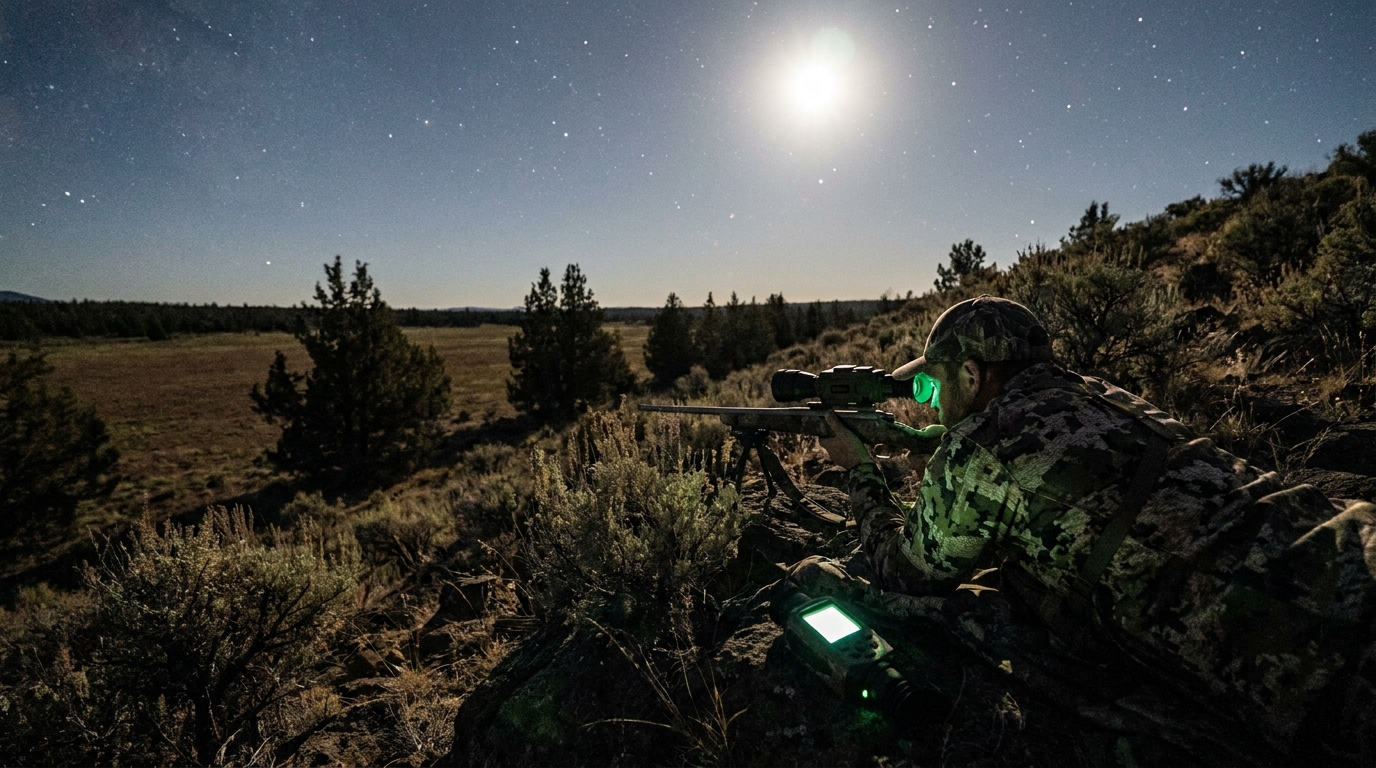
Five years ago, thermal optics were a luxury reserved for military contractors and a handful of well-funded predator hunters in Texas. Today, quality thermal monoculars start under $400 and handheld thermal scopes capable of taking coyotes at 200 yards are in the $1,200-2,000 range. This technology shift has changed predator hunting in Oregon fundamentally—the coyote that was invisible at 11 PM is now a bright orange blob against a cool field. If you hunt predators and haven't looked into thermal or digital night vision, it's time to pay attention.
Oregon Law: What's Legal
Before spending money, understand the legal framework. In Oregon:
- Coyotes, nutria, and feral swine may be taken at night by licensed hunters with any legal firearm. Night vision and thermal optics are legal for these species.
- Raccoons and skunks may be taken at night during their respective seasons—check current ODFW regulations for method restrictions.
- Big game (deer, elk, bear, etc.) cannot be hunted at night under any circumstances. Thermal optics do not create a legal right to pursue game that is otherwise restricted to daylight hours.
- State and federal lands: Confirm that the specific area you're hunting allows night hunting. Some state forests have additional restrictions. BLM and National Forest lands generally allow night predator hunting unless otherwise posted.
Bottom line: thermal and night vision are legal tools for Oregon coyote hunters on most public and private land. Know your target species and verify access permissions before heading out.
Thermal vs. Digital Night Vision: What's the Difference?
Thermal imaging detects heat signatures—it does not require any ambient light. Warm-blooded animals show up clearly against a cooler background regardless of darkness, fog, or light brush. Thermal cannot see through glass (you can't use it through a standard scope), and the image is a heat map rather than a true visual representation. It's the most effective technology for detecting and tracking animals at night.
Digital night vision (DNV) amplifies available light—moonlight, starlight, or IR illumination from an integrated or attached IR emitter. DNV produces a clearer, more photographic image than thermal, and modern units can be used as day/night optics. Range is limited by the IR illuminator and ambient light. DNV is generally less expensive than thermal for equivalent performance.
For most predator hunters, the practical answer is: use a thermal monocular for detection and scanning, and either a thermal clip-on or digital night vision scope for shooting. Many experienced night hunters carry both.
Recommended Thermal Units by Budget
Under $600 — Detection/Scouting
Pulsar Axion XM30S: A compact thermal monocular with a 320x240 sensor and 30mm objective. Detects human-sized heat signatures at 800+ meters. Excellent battery life and user interface. Not a shooting optic—this is your handheld spotter for scanning fields and verifying targets before you call them in.
Guide TD210: Chinese-made but solid. 256x192 sensor, adequate refresh rate, rechargeable battery. Good entry-level detection tool. Image quality doesn't match Pulsar but it works.
$1,200-2,500 — Shooting Optics
Pulsar Thermion 2 XP50: This is the benchmark thermal rifle scope in the mid-range tier. 640x480 sensor, 50mm objective, 2.5-20x magnification. Clear image at 200-300 yards on a coyote-sized target. Holds zero reliably and mounts on standard 30mm rings. Available in .jpg and video clip recording. At $2,200-2,400 street price, it's an investment, but it's also a purpose-built tool that will outlast fashion and budget scopes.
InfiRay Outdoor RICO G 640: Strong competitor to the Pulsar at similar price points. 640 sensor, excellent clarity. The InfiRay ecosystem has expanded rapidly and their image quality is competitive at every tier.
ATN Thor 4 640: American-designed, feature-heavy thermal scope with ballistic calculator, recoil-activated video, and range-finding integration. The software can be buggy and battery life is modest, but the raw image is good and the feature set is unmatched at this price.
Budget Digital Night Vision ($300-800)
ATN X-Sight 4K Pro: Digital day/night scope with good daytime glass and passable night performance using the built-in IR illuminator. Works to about 100 yards on coyotes under dark sky. Popular with hunters who want one optic for day and night use without spending thermal money.
Sightmark Wraith 4K: A solid value in DNV scopes. Ships with a 4K sensor and an IR illuminator that provides usable range to 150 yards under dark conditions. Battery life is adequate for a full night session.
Building a Practical Night Hunt Setup
A working Oregon coyote night hunt setup looks like this:
- Primary calling platform: .223 or .22-250 rifle with a thermal clip-on or dedicated thermal scope
- Handheld thermal monocular for pre-hunt scanning and locating distant animals
- Electronic caller with remote operation (FoxPro, Primos, or similar)
- Red or green light (for backup ID and close-range movement)
- Shooting sticks or bipod—precise shot placement matters more at night
Thermal does not replace hunting skill. Reading the wind, setting up with the thermal optic facing downwind, understanding how to manage the call sequence—all of that still applies. The technology reveals the target; the hunting still has to happen.
The Bottom Line
If you call coyotes in Oregon and you've been doing it purely in daylight, thermal will open up a whole new world of productive hours. The hours between 10 PM and 3 AM are often the most active for coyotes, especially on pressured ground. Budget a minimum of $400 for a detection monocular and $1,200 for a quality shooting optic, and you'll have a setup that's effective for years. Buy cheap thermal once and you'll end up buying quality thermal twice.