Most Oregon backpackers spend their trail time in the Cascades. The Coast Range tends to get overlooked — wetter, denser, harder to navigate, and without the dramatic alpine views that drive permit demand in places like the Three Sisters or Wallowas. That relative obscurity is exactly what makes the Drift Creek Wilderness one of the best overnight destinations in the state. No permit. No crowds. Just ancient forest, a wild coastal stream, and the kind of green stillness that feels increasingly rare.
About the Drift Creek Wilderness
Located in Lincoln County approximately 10 miles southeast of Lincoln City, the Drift Creek Wilderness encompasses 5,798 acres of Siuslaw National Forest managed by the USFS. The wilderness was established in 1984 specifically to protect a significant remnant of old-growth temperate rainforest — Sitka spruce, western red cedar, western hemlock, and Douglas-fir that were never logged when surrounding lands were cleared in the 20th century.
Drift Creek itself is a tributary of the Siletz River system and supports runs of wild coho salmon and winter steelhead — you'll see spawning redds if you visit in fall or winter. The entire watershed is a functioning old-growth ecosystem in a region where such things are vanishingly rare.
The Trail System
Two primary trails access the Drift Creek Wilderness:
Drift Creek Trail (Primary Route)
- Trailhead: Drift Creek Trailhead off NF-17 (Siuslaw National Forest Road 17), accessed from Hwy 101 south of Lincoln City
- Distance: 3.7 miles one-way to the confluence area
- Elevation change: ~1,200 feet total — a significant descent into the creek drainage, which means a significant climb on the way out
- Surface: Well-maintained trail through old-growth, some root and mud sections in wet weather
Harris Ranch Trail
- Trailhead: Harris Ranch Trailhead off NF-1553
- Distance: 2.7 miles one-way to the creek
- Character: Shorter approach, slightly less dramatic old-growth but easier grade
A loop trip connecting both trailheads (via an informal connecting route along the creek) makes an excellent 2-day itinerary. The creek crossing between trail systems is not bridged — wade crossing or scouts for log crossings required depending on water level.
Weekend Itinerary: 2 Days, 1 Night
Day 1: Drift Creek Trailhead to Creekside Camp
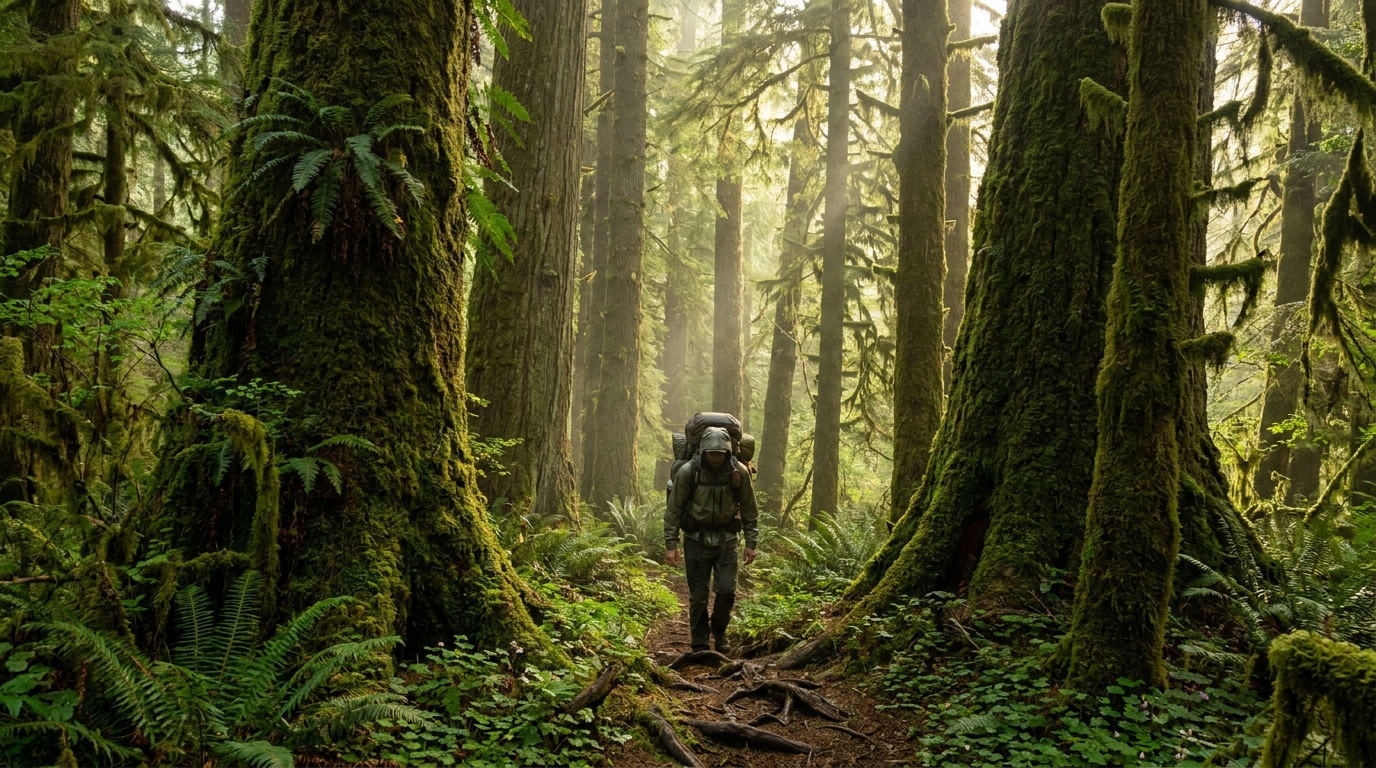
Start at the Drift Creek Trailhead and begin the descent into the wilderness. The trail drops steadily through towering Sitka spruce with understories of sword fern and oxalis so dense they form a continuous green carpet. Old-growth trees here are enormous — Sitka spruce measuring 6–8 feet in diameter are common, and a few ancient individuals exceed 10 feet. These trees are 400–600 years old.
At roughly the 2-mile mark the trail parallels a side tributary before reaching the main Drift Creek drainage. Camp anywhere in the riparian zone near the creek following Leave No Trace practices — this is a dispersed camping wilderness, no designated sites. Best spots are on gravel bars set back from the active channel, which can rise quickly during rain events.
Distance: 3.7 miles | Elevation loss: ~1,200 ft | Time: 2–3 hours
Day 2: Creek Exploration, Then Out via Harris Ranch
Wake up to the sound of the creek and old-growth birdlife — varied thrushes, winter wrens, Pacific-slope flycatchers, and if you're lucky, marbled murrelets nesting in the old-growth canopy. Spend the morning fishing or exploring the creek upstream before heading out via the Harris Ranch Trail for a different perspective on the return.
Distance: ~4.5 miles out | Time: 3–4 hours
Fishing Drift Creek
An Oregon fishing license is required. The creek supports native cutthroat trout in the upper reaches and is open to fishing under standard ODFW western Oregon regulations. Small spinners and dry flies work well for cutthroat. Check ODFW regulations carefully — tributary closure rules apply in many coastal streams during certain seasons to protect salmon and steelhead redds.
Seasonal Considerations
The Coast Range operates on a different calendar than the Cascades:
- Summer (June–September): Best weather window. Expect morning fog that burns off by midday, comfortable temperatures in the 55–70°F range at the creek bottom, and dry trail conditions. This is peak season — though even peak season in Drift Creek means light use compared to Cascade wilderness areas.
- Fall (October–November): Coho and steelhead begin moving into the system. Stunning old-growth color (maple and vine maple turn gold against the evergreen backdrop). Rain begins in earnest by late October — waterproof everything.
- Winter (December–March): Heavy rain, swollen creek, challenging but atmospheric. Hardcore wilderness visitors only. Creek crossings may be impassable.
- Spring (April–May): Wildflowers on the hillside approaches, creek running high but stabilizing. Expect muddy trail conditions and plentiful mosquitoes by May.
What to Pack
The Coast Range demands different gear than the Cascades. Plan for wet conditions even in summer — the forest floor and undergrowth hold moisture, and marine fog can leave gear damp overnight even without rain.
- Rain gear: Hardshell jacket and pants — not just a windshell. This is rainforest.
- Footwear: Waterproof hiking boots, or accept wet feet. The creek crossings and perpetually damp trail conditions will soak trail runners within the first mile.
- Shelter: A well-seam-sealed tent. Tarps work for experienced users familiar with the terrain but leave less margin in heavy Coast Range rain.
- Water filter: Drift Creek water is excellent quality, but filter everything. A squeeze filter or SteriPen handles the volume you'll need at camp.
- Bug protection: Ticks are present in Coast Range grassland margins in spring. Do a tick check after the first mile of open hillside trail. DEET or permethrin-treated clothing is a reasonable precaution.
Getting There
From Lincoln City: Take Hwy 101 south to the Drift Creek Road turnoff (approximately 4 miles south of Lincoln City). Follow signs toward Siuslaw National Forest Road 17. The Drift Creek Trailhead is approximately 10 miles from Hwy 101 on paved and well-maintained gravel road. High-clearance recommended in wet conditions but not required in summer.
No fee. No permit. Just show up. That's increasingly rare for a wilderness of this quality in Oregon, and it's reason enough to make the trip before that changes.