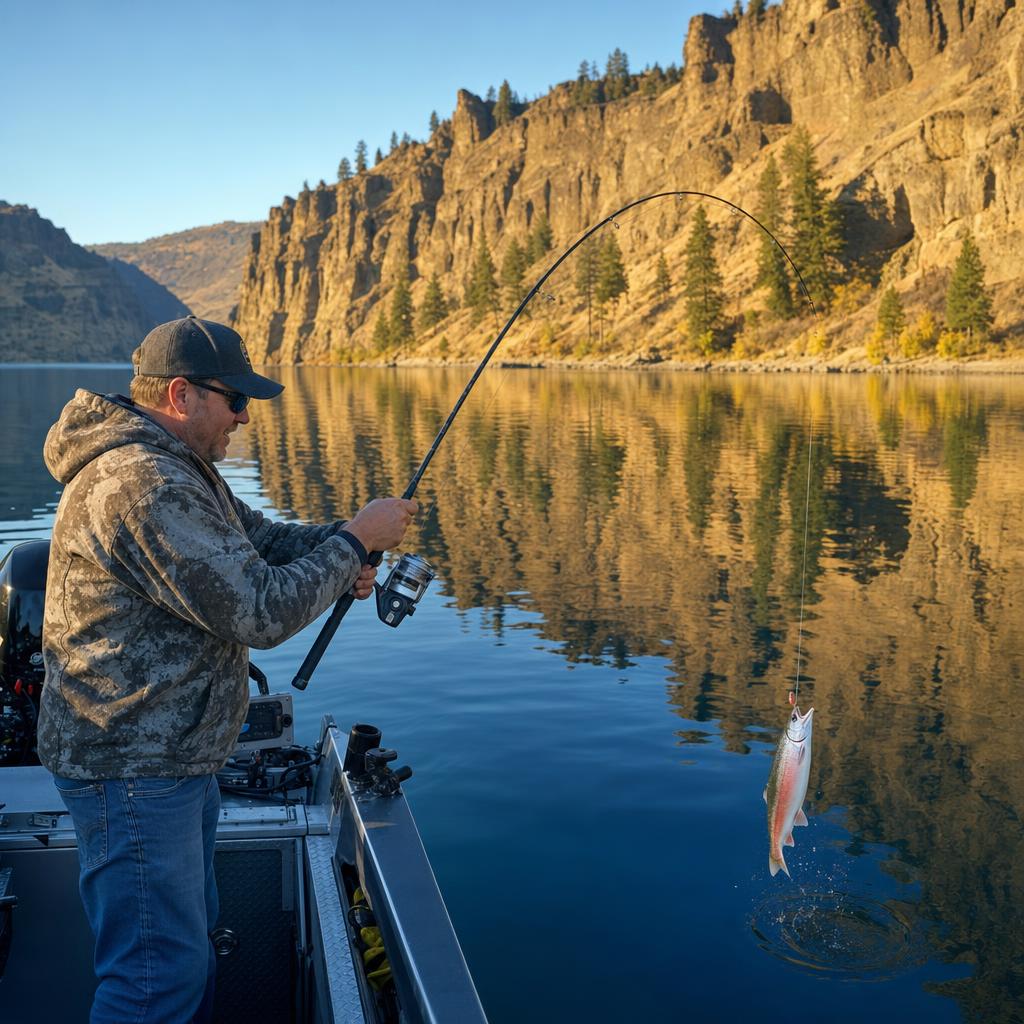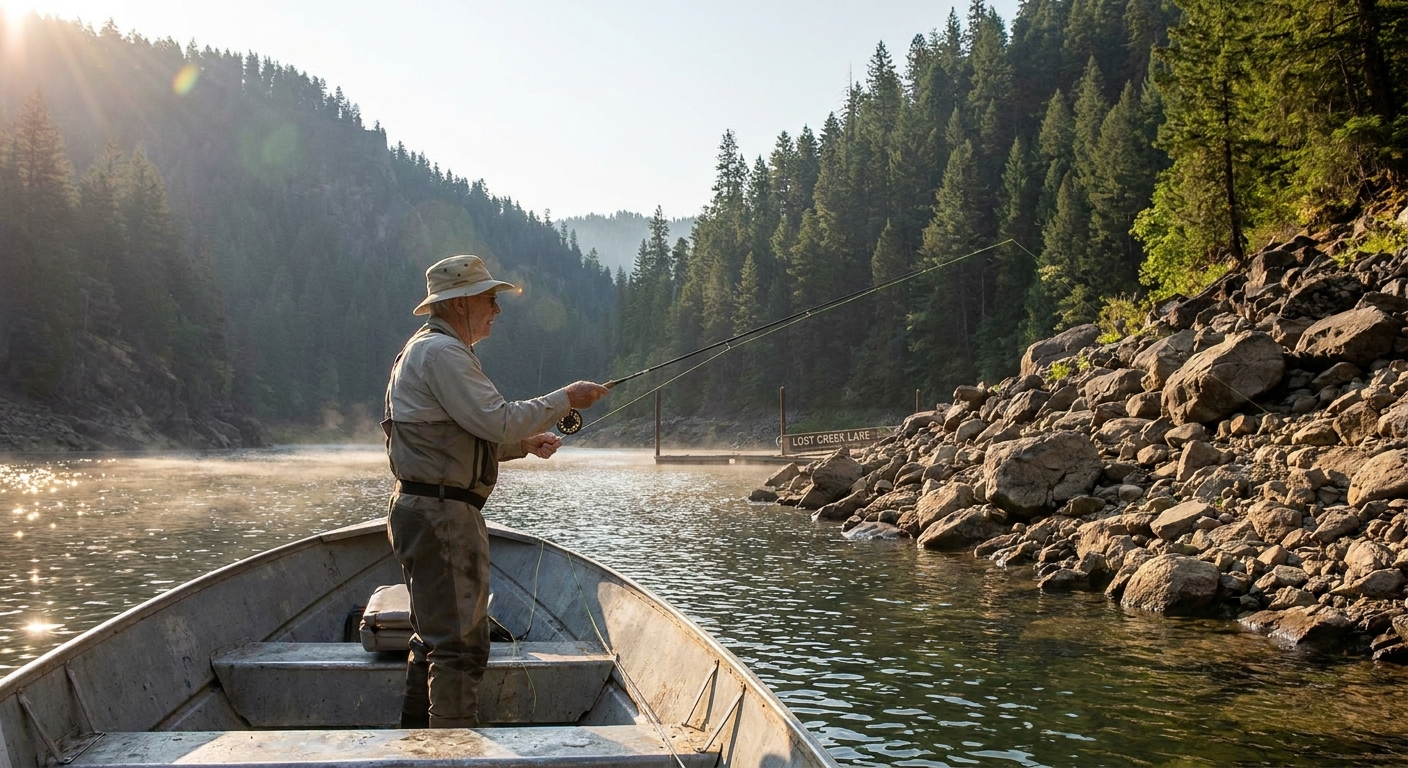
If you ask most Oregon anglers to name the top summer fisheries in the state, Lost Creek Lake rarely comes up in the same breath as Crane Prairie, Wickiup, or Wallowa Lake. That's a mistake—and one that leaves this deep, clear reservoir in Jackson County relatively uncrowded through July and August while other destinations are shoulder-to-shoulder with boats. Lost Creek holds a legitimate shot at multiple species in a single trip: trophy brown trout, kokanee salmon, largemouth and smallmouth bass, and a stout population of rainbow trout. Here's how to approach it.
The Lake at a Glance
Lost Creek Lake sits at roughly 1,840 feet elevation in the western Cascades, formed by the William L. Jess Dam on the upper Rogue River. At full pool it covers about 3,430 acres with a maximum depth near 200 feet. The lake is managed jointly by the U.S. Army Corps of Engineers and ODFW, and it receives regular stockings of rainbow trout and kokanee. The reservoir also holds naturally reproducing populations of smallmouth and largemouth bass, as well as some of the largest brown trout in the Rogue Basin.
Kokanee: The Summer Priority
Lost Creek's kokanee salmon are the main draw for most visiting anglers from June through September. These landlocked sockeye run 10–16 inches in typical years, with the occasional fish pushing 18 inches. They school tightly in the thermocline, which at Lost Creek usually settles between 35 and 55 feet by mid-June.
Tackle and Technique
- Downrigger trolling is the most consistent method. Set your cannonball to put your lure at the top of the thermocline, then adjust 5 feet at a time until you find active fish.
- Kokanee-specific gear like Ford Fenders or Mack's Wedding Ring spinners in chartreuse, pink, or orange tipped with a white shoepeg corn kernel is deadly here.
- Troll at 1.2–1.8 mph. Much faster and you'll turn them off; much slower and the blade action dies.
- A quality fish finder matters. Kokanee mark well at depth—look for dense clouds of marks within the thermocline and position your lures just above the main school.
The best kokanee bite typically runs from early morning through about 10 AM, then picks back up in the evening. Midday, when the sun hits the surface and fishing slows, is a good time to shift to bass.
Largemouth and Smallmouth Bass
Lost Creek's bass population doesn't get the press it deserves. The upper arms of the reservoir—particularly the Elk Creek arm and the main Rogue arm above the highway 62 bridge—hold good numbers of largemouth in the shallower, warmer water. Smallmouth dominate the rockier main-lake habitat and the dam-end of the reservoir.
Summer Bass Strategy
- Early morning: Work topwater lures (Zara Spooks, poppers, buzzbait) along shallow rocky banks and any wood structure you can find. Lost Creek has limited timber in the water, but the chunks that remain are magnets.
- Midday: Drop-shot rigs with 4-inch Roboworms in morning dawn or green pumpkin along rocky points and ledges in 12–25 feet. Smallmouth in particular suspend just off the bottom in the 15–20 foot range when water temps exceed 70°F at the surface.
- Evening: Return to shallow structure with finesse jigs or creature baits on a Texas rig. The largemouth move shallow again to feed as shadows lengthen.
Brown Trout: The Trophy Wild Card
Lost Creek's brown trout population is underutilized and underestimated. Fish in the 18–24 inch range are not rare, and the occasional bruiser pushing 5–6 pounds is taken by anglers who target them specifically. Browns in Lost Creek feed heavily on the kokanee population, so large jointed swimbaits and Rapala-style lures trolled near the inflow areas and rocky points at the upper end of the lake can draw savage strikes in low-light conditions.
Dedicated brown trout anglers often launch at Takelma Park or the boat ramp near the dam and run to the upper Rogue arm at first and last light. Match your lure color to the kokanee—silver and pink, or silver and blue—and troll a single line 6–10 feet down through transitional zones between rocky points and the open basin.
Access and Logistics
The primary boat launch at Lost Creek Lake is the Joseph H. Stewart State Recreation Area, located off Highway 62 about 35 miles northeast of Medford. The park has full hookup RV sites, tent camping, and a two-lane concrete boat ramp with a courtesy dock. A second ramp at Takelma Park provides additional access on the upper lake. Day use fees apply; Oregon State Park annual passes are accepted.
The nearest tackle and supplies are in the town of Shady Cove, just below the dam on the lower Rogue. Stock up there before heading to the lake—services at the reservoir itself are limited to the park store at Stewart State.
Regulations Snapshot
Lost Creek Lake falls under the Rogue River drainage regulations in the current Oregon Sport Fishing Regulations. Check the ODFW synopsis each season—bass limits, trout daily bag limits, and kokanee regulations can change year to year. A valid Oregon fishing license and Combined Angling Tag (if targeting salmon/steelhead in the same trip) are required.
The Bottom Line
Lost Creek Lake rewards anglers willing to think beyond the obvious. On a single summer day you can land kokanee on the downriggers at dawn, shift to topwater bass fishing through the middle of the morning, target suspended smallmouth with drop-shot gear at midday, and end the evening dragging a big swimbait through brown trout territory. That kind of versatility in a single Southern Oregon reservoir is hard to beat—and the fact that it's still flying under the radar just makes it sweeter.