When most Oregon bowhunters think mule deer, they think eastern Oregon — the Ochocos, the Blue Mountains, the Hart Mountain basin. The Metolius Unit rarely comes up in those conversations, which is exactly why it should be on your radar. This unit, centered around the Metolius River drainage west of Madras and the ponderosa pine country east of Black Butte, holds a solid population of mule deer with less hunting pressure than the more celebrated eastern units.
The archery season opens statewide in mid-August, and by now — mid-July — you still have four to six weeks to do your legwork. This is the window that separates filled tags from punched-out deer camp stories.
Know the Unit
The Metolius Unit covers a significant chunk of central Oregon between Highway 26 to the north, the Deschutes River corridor to the east, the Cascades foothills to the west, and the Santiam Pass vicinity to the south. It’s a mosaic of ponderosa pine benches, juniper draws, sage flats, and steep canyon country dropping into the Metolius and Deschutes drainages.
The Deschutes National Forest makes up a large portion of the huntable ground, and most of it is open to foot traffic without special permits. OnX Hunt maps will be your best friend for identifying land ownership boundaries, but the public access is generally good if you’re willing to hike.
July Scouting Strategy
Mule deer bucks in the Metolius Unit spend July in predictable patterns. They’re focused almost entirely on feed and water, and they haven’t had hunting pressure in months. This makes them vulnerable to glassing — if you put in the time behind a spotting scope, you will find bucks.
Glass the Edges at First Light
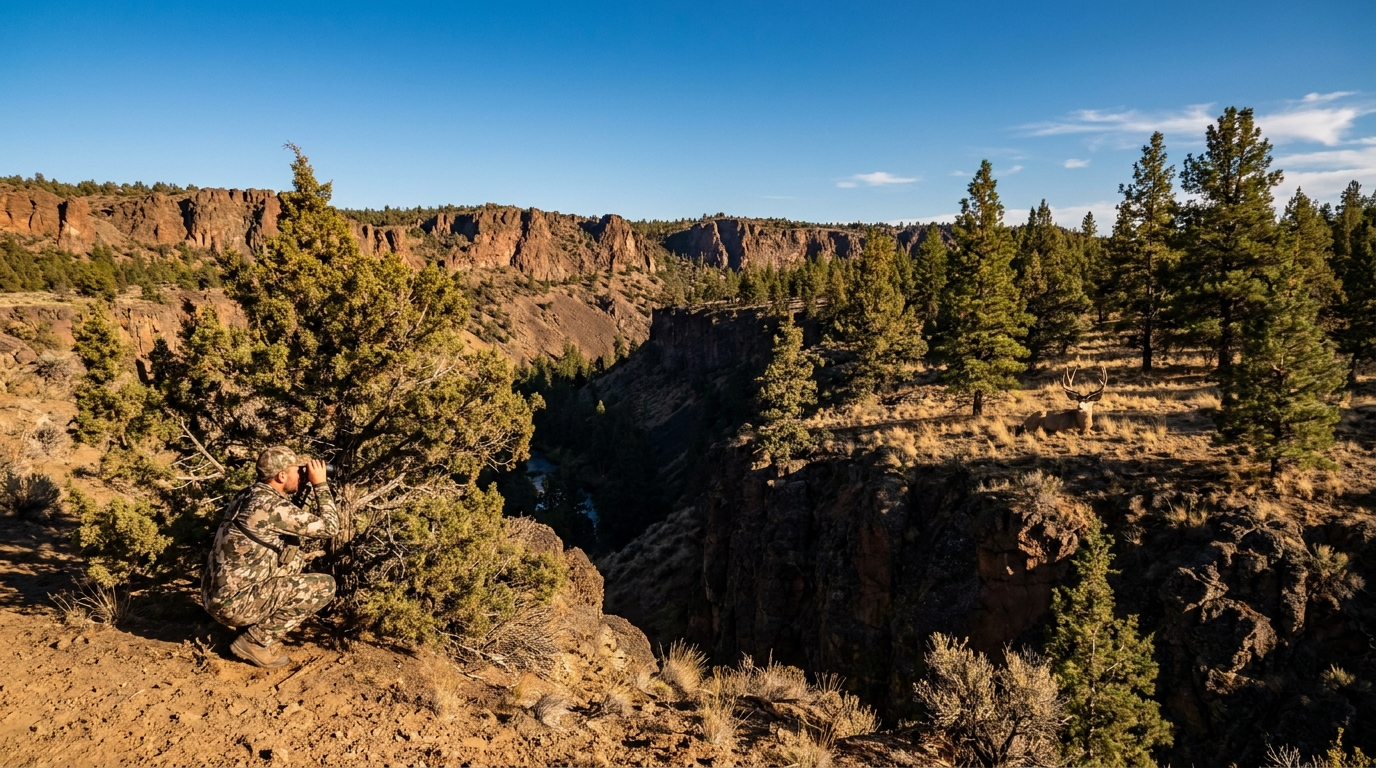
The transition zones between open sage and ponderosa timber are your primary targets in July. Bucks feed in the open draws and sage flats during the last hour of light and the first hour after sunrise, then drift into the timber to bed by 8 or 9 AM. Set up on a high vantage point overlooking a south-facing slope with mixed juniper and sage below and find an edge where the pines start. Glass methodically from 200 to 600 yards using a quality 80mm to 85mm spotting scope at 45-60x.
Water Sources
In July, water is the key to finding deer in the Metolius Unit. Stock ponds, developed springs, and the riparian areas along creeks feeding into the Metolius all concentrate deer during hot afternoons. Run your OnX app to identify water sources on public land and plan evening sits near the most remote ones — those that require a 2-mile walk will see a fraction of the pressure of water sources accessible by road.
Focus on Elevation
By mid-July, mature bucks in this unit are often higher than you’d expect — pushed up by heat and biting insects into cooler country in the 4,500- to 5,500-foot range on the Deschutes National Forest. These bucks are harder to reach but far less pressured. The Black Butte area and the higher benches north of Sisters toward the unit’s southern boundary repay the extra miles.
Hunting the August Opener
Oregon’s archery opener typically falls in the third week of August. Bucks will still be in velvet for the first few days — a significant advantage for the bowhunter, since velvet bucks tend to be less skittish and more predictable in their movements than hard-antlered animals post-rut.
Spot and Stalk vs. Water Sources
Both tactics work in the Metolius Unit, and which you use depends on terrain and wind. The open sage and juniper country on the unit’s eastern side lends itself to spot-and-stalk: glass bucks from distance, plan an approach using terrain, and close the gap. The timbered sections are better suited to ambush hunting — either over a water source or on a travel corridor between bedding and feeding areas.
Wind Is Everything
Metolius Unit thermals are predictable in stable summer weather: uphill in the morning as the land heats, downhill in the evening as it cools. Plan your approaches accordingly. A morning stalk should generally work uphill into the thermal; an evening approach from above going to a water source means you’re fighting the thermals. Adjust accordingly or use the canyon topography to your advantage.
OTC Tag, Realistic Expectations
The Metolius Unit is an over-the-counter archery tag — no draw required. That’s both good and bad. Good because you can plan a last-minute trip; bad because opening week will see other hunters in the field. The unit is large enough that pressure disperses quickly, and deer that get bumped by opening-day traffic often simply relocate a mile or two rather than abandoning their home range.
Mature bucks here average 20 to 24 inches of spread with 3x3 or 4x4 frames. A genuine trophy unit the Metolius is not — but a huntable population with realistic odds for a bowhunter willing to put in scouting time? Absolutely.
What to Pack
- Quality 10x42 binoculars and an 80mm+ spotting scope — glassing is 80% of the work
- OnX Hunt loaded with Deschutes National Forest data and water sources marked
- A lightweight pack setup for 3-5 mile day hunts in warm weather
- Plenty of water — summer hunting in the high desert is dehydrating work
- Light layers — morning starts at altitude can be cold even in August
- Scent control — less critical in the sage country with consistent wind, but don’t get lazy
One More Thing
Do your boots-on scouting before August. The bucks you find in July feeding confidently at a water source at 6 AM will be in roughly the same area when the opener arrives. They don’t read calendars. But they do pattern hunters — which is why every vehicle and every human scent you leave on the landscape in the weeks before the opener costs you something. Scout hard in July. Go light in August. Fill the tag.