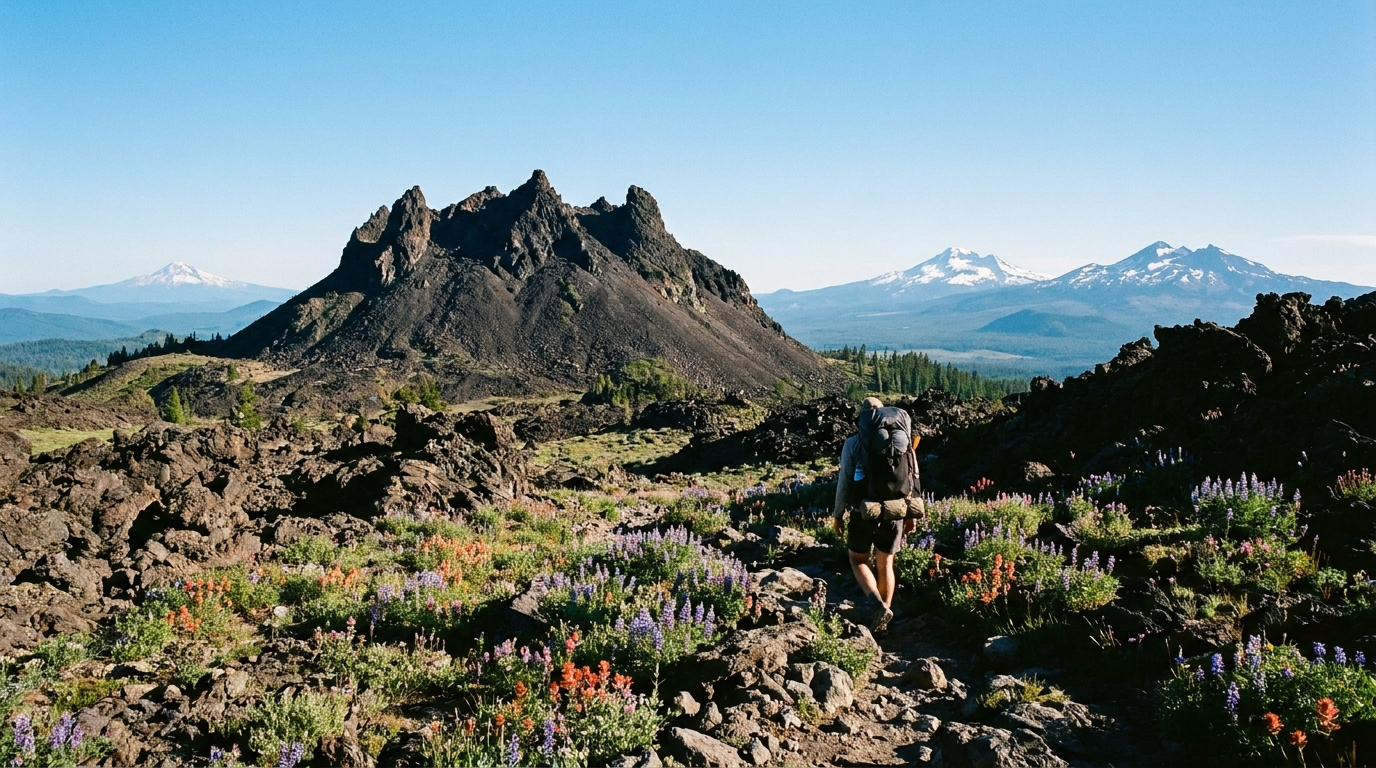
Oregon's Cascade Range is full of wilderness areas, but few are as visually striking or as physically demanding as the Mount Washington Wilderness. Located along the Cascade Crest between Sisters and McKenzie Pass, this 52,000-acre wilderness is defined by sweeping lava fields, ancient basalt flows, and the ragged black spire of Mount Washington rising to 7,794 feet. It is a place that genuinely earns the word wilderness — trail miles are hard, water sources are sparse, and the sun-baked lava fields in July and August are brutally exposed. But for the backpacker who puts in the effort, the rewards are proportionate.
This guide covers a 2-day loop accessible from the McKenzie Pass trailhead, covering approximately 18 miles with 2,400 feet of cumulative elevation gain. The route is suitable for fit hikers with desert-style backpacking experience. Early summer (late June through July) offers the best conditions — snow clears early here due to the exposed terrain, and mosquitoes are minimal compared to the wetter Cascades.
Getting There
Drive Highway 242 (McKenzie Pass Scenic Highway) east from McKenzie Bridge toward Sisters. The road typically opens by late May or early June after winter snow clears. Park at the Dee Wright Observatory trailhead at McKenzie Pass. This is where the journey begins, surrounded by one of the most extensive lava flows in the continental United States — the 1,500-year-old Belknap Lava Field. Trailhead elevation is approximately 5,325 feet.
Day 1: McKenzie Pass to Coldwater Spring Camp (9 miles)
From the Dee Wright Observatory, pick up the Pacific Crest Trail heading north. The first three miles are through open lava — black basalt under full sun with almost no shade. Gaiters are valuable here, as the sharp lava shreds trail runners and low-cut hikers quickly. The trail is well-marked but the terrain is relentless. Carry more water than you think you need: the first reliable water is not until the pine forest picks up near mile four.
As you gain elevation above the main lava field, the landscape transitions to subalpine forest — mountain hemlock, whitebark pine, and subalpine fir begin to appear. Views of Mount Washington improve dramatically, the jagged plug dome of the summit rising to the west of the trail. The PCT and the Skyline Trail connect here, giving you options to adjust your route.
Camp near Coldwater Spring at approximately mile 9. This is one of the few reliable water sources in the northern portion of the wilderness. The spring flows consistently through midsummer but can slow by September — cache water here for the morning. Camp on existing impact sites and follow Leave No Trace principles; the Mount Washington Wilderness sees less foot traffic than Three Sisters but is still showing pressure in popular areas.
Day 1 Highlights
- Dee Wright Observatory — 360-degree views from the lava-built stone lookout structure
- Belknap Crater — Visible from trail, a shield volcano capping the main lava flow
- First clear views of Mount Washington's distinctive summit spire at miles 4-5
Day 2: Coldwater Spring to Trailhead via Benson and Scott Lakes (9 miles)
From camp, the route swings east and descends through old-growth mountain hemlock toward the Benson and Scott Lake area. These shallow, lily-padded lakes are photogenic and support fair fishing for brook trout and rainbow — a 5-weight packable fly rod or ultralight spinning setup is worth the weight for a lakeside lunch session. Both lakes warm enough by July for an optimistic swim in the mid-60s.
From Scott Lake, the trail follows the base of the high terrain back to McKenzie Pass, crossing several small drainages that flow reliably through July. The final two miles parallel the highway and return you to the Dee Wright trailhead with Mount Washington looming as a final goodbye across the lava plain.
Gear Considerations for Lava Country
Mount Washington Wilderness demands a slightly different gear approach than a typical Oregon Cascades backpack:
- Footwear — Boots or trail runners with aggressive outsoles and protective uppers. The lava will destroy ultralight footwear quickly. Gaiters are highly recommended for the McKenzie Pass approach miles.
- Sun protection — The exposed lava amplifies UV exposure dramatically. Sun hat, sunglasses, and SPF 50 applied generously are non-negotiable on the open portions of this route.
- Water capacity — Carry at least 3 to 4 liters between known water sources. The long dry stretches through lava fields on Day 1 will drain your supply faster than you expect, especially in summer heat.
- Navigation — The PCT is well-signed, but carry a map and compass or load the route on a GPS device. Some trail junctions in the wilderness are marked only by cairns, and weather moves in fast on the Cascade Crest.
- Tent stakes — Bring heavy-duty aluminum stakes. Ground in the lava-sandy soil is loose and conventional tent stakes pull out easily in evening winds.
Permits and Regulations
The Mount Washington Wilderness does not currently require a permit for overnight travel, though a Northwest Forest Pass is required for parking at the Dee Wright Observatory trailhead. Campfires are prohibited within the wilderness during fire season, which typically runs from mid-July through October. A gas stove is both lighter and legal. Check current fire restrictions with the Willamette National Forest McKenzie River Ranger District before your trip.
The Mount Washington Wilderness rewards those willing to work for it. The lava is hard on feet and morale in equal measure, but the views, the solitude relative to nearby Three Sisters, and the surreal black-rock-and-blue-sky landscape make it one of the most visually distinct backpacking experiences in the Oregon Cascades. Go with enough water, solid boots, and a genuine appreciation for volcanic geology, and it will not disappoint.