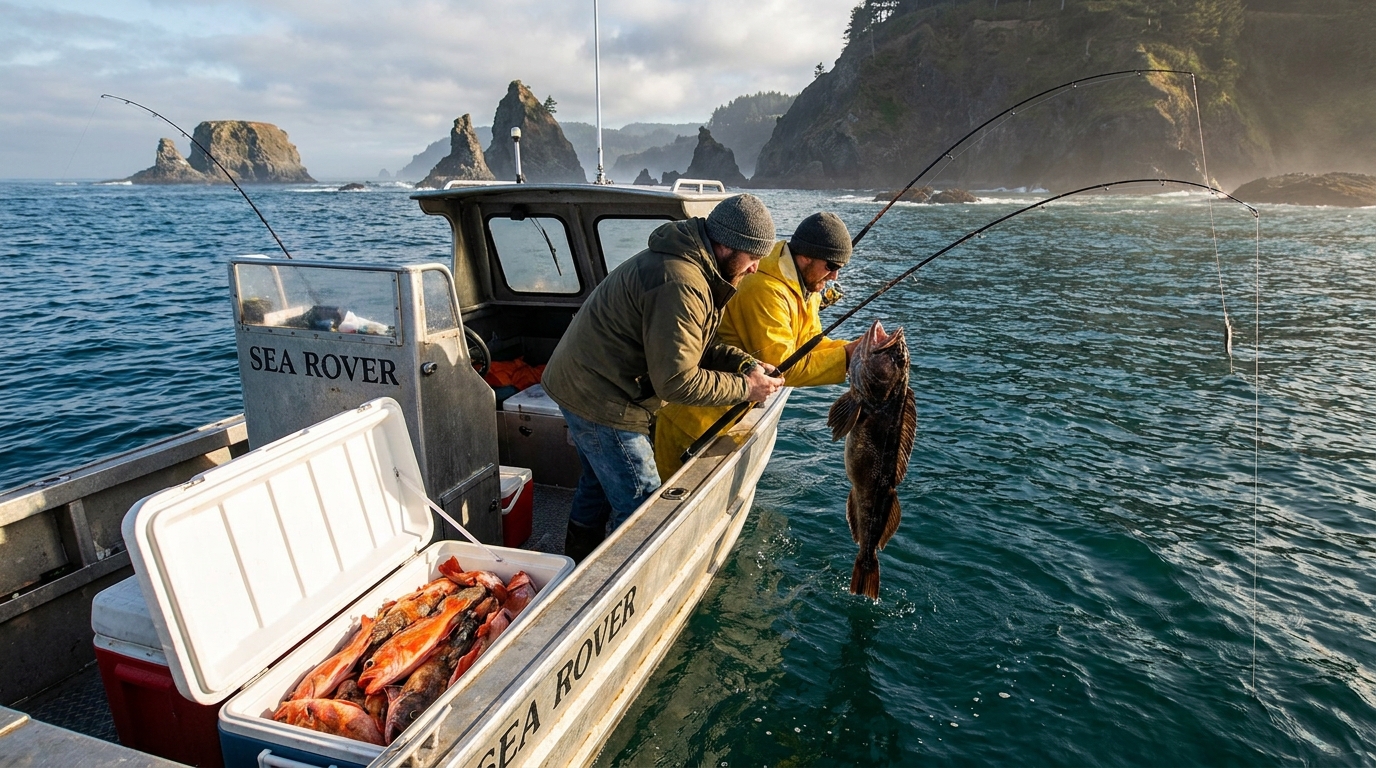
Oregon's nearshore rockfish and lingcod fishery is one of the Pacific Coast's best-kept secrets among inland anglers, but coastal regulars know the truth: when the summer bottom fishing season opens on June 1st, the action can be spectacular. Rocky reefs from Brookings to Astoria hold dense populations of black rockfish, blue rockfish, cabezon, and the hard-hitting lingcod — all of which are legal to pursue from a boat during the open season.
Whether you're launching from Depoe Bay, Garibaldi, Winchester Bay, or Gold Beach, this guide will put you on fish. We'll cover where to find them, what gear to run, how to work the bottom, and how to stay on the right side of ODFW's nearshore regulations.
Understanding Oregon's Nearshore Bottom Fish Seasons
Oregon's nearshore regulations can be confusing if you're used to freshwater simplicity. For 2026, the general nearshore rockfish season runs June 1 through December 31 inside the 40-fathom (240-foot) depth contour. Lingcod have their own season — typically July 1 through December 31 — so check current ODFW guidelines before you target them specifically. The daily bag limits are generous: 10 rockfish combined species (with some restrictions on specific species like cabezon at 3 per day), and 2 lingcod per day.
Always verify current regulations at myodfw.com before launching. Nearshore rules can shift mid-season based on stock assessments, and ignorance of a regulatory change is no defense with ODFW wardens.
Best Ports for Nearshore Bottom Fishing
Depoe Bay — The Pocket Port
The world's smallest navigable harbor gives access to some of the richest reefs on the coast. The rocky bottom structure immediately offshore of Depoe Bay holds black and blue rockfish in numbers that will fill a cooler quickly. The area known as "The Reef" just outside the harbor mouth is a classic black rockfish drift, and bait-fishing in 50–80 feet of water produces cabezon and lingcod with regularity.
Winchester Bay — Gateway to the Deep Reefs
Launching from the Umpqua River and heading offshore, Winchester Bay anglers can reach productive rocky reef structures in 60–120 feet of water within a short run. The reefs south toward Cape Arago are particularly productive for lingcod. This port also offers easy access to the nearshore kelp forests where black rockfish school aggressively near the surface in summer.
Gold Beach — Southern Oregon's Hidden Gem
The mouth of the Rogue River gives Gold Beach anglers access to both a world-class salmon fishery and excellent nearshore rockfishing. The rocky reefs between Humbug Mountain and Cape Sebastian are serious lingcod territory, with fish pushing 15–20 pounds not uncommon in water as shallow as 40–60 feet.
Gear and Tackle Setup
Rods and Reels
For nearshore bottom fishing, a 7–8 foot medium-heavy conventional rod paired with a level-wind or baitcasting reel spooled with 40–65 lb braided line is the workhorse setup. Braid's low stretch gives you exceptional bottom feel and positive hooksets in depths up to 150 feet. Run a 3–5 foot fluorocarbon leader of 30–40 lb test to the terminal rig.
Terminal Rigs
- Dropper loop rig: The standard Oregon bottom rig — a 4–8 oz bank sinker on the bottom, two dropper loops 12 and 24 inches above it, each rigged with a 3/0–5/0 baited hook. Effective for mixed bags of rockfish and cabezon.
- Iron jigs: 2–4 oz white, chartreuse, or pink metal jigs work exceptionally well for black rockfish near the surface and aggressive lingcod on the bottom. Jig it vertically with sharp lifts and drops.
- Swimbaits: 3–5 inch paddle-tail swimbaits on a 1–2 oz ball head are devastatingly effective for lingcod. Work them just off the bottom with slow retrieves and occasional pauses.
Best Baits
Fresh squid is the go-to bait for nearshore bottom fishing — it's durable, smells right, and attracts nearly everything. Cut herring, sardine, and even strips of fresh rockfish work well. For cabezon specifically, fresh crab or shrimp fished on the bottom near rocky structure is hard to beat.
Reading Bottom Structure
Rockfish and lingcod are structure fish. They live on rocky reefs, underwater pinnacles, kelp beds, and drop-offs — anywhere that breaks the monotony of a sand bottom. Your fish finder is your most important tool. Learn to read the returns: hard bottom shows as a thick, bright line, while soft sand shows a thinner return. Boulders and reef edges appear as irregular peaks above the bottom line.
On calm days, polarized sunglasses can help you spot kelp beds from the surface — these almost always overlie rocky reef structure holding fish below. Mark productive waypoints in your GPS when you find them; these spots produce year after year.
Fishing the Drift
Most nearshore bottom fishing is done on the drift. Approach the reef with the wind or current, cut the motor, and let the boat drift naturally over the structure while anglers fish vertically. Keep your weight bouncing lightly on the bottom — if you're constantly hung up, you're doing it right on the rocky stuff that holds fish.
When the bite is on, mark the GPS coordinates and motor back upwind to drift through again. Productive drifts can produce fish on every pass through a reef system.
Cleaning and Keeping Your Catch
Rockfish and lingcod are outstanding table fare. Lingcod has firm, white, mild-flavored meat that's excellent fried, grilled, or baked. Black rockfish fillets are similar in texture and take seasoning beautifully. Keep fish in a cooler with plenty of ice from the moment they come over the rail — rockfish are a warm-water species that deteriorates quickly in the summer heat.
Note that many rockfish species (particularly yelloweye, canary, and bocaccio) are catch-and-release only due to conservation status. Know your rockfish identification before you head out, and carry a venting tool to safely release deep-caught fish with barotrauma.
Safety on the Oregon Coast
The Oregon bar crossings at Garibaldi, Winchester Bay, and other ports can be genuinely dangerous in rough conditions. Always check the marine forecast through the National Weather Service's Portland or Medford offices before launching, and respect bar closure advisories from the Coast Guard. Oregon's nearshore can turn ugly fast — be conservative with sea conditions, file a float plan with someone ashore, and carry all required USCG safety equipment.
The fish will be there next weekend if conditions aren't right today. The reefs don't go anywhere.